Family, dice and table games in Parlour
Snakes and Ladders, free on iPhone, iPad and Android
Roll, count, climb, slide. Snakes and Ladders is the first board game many children learn, and one of the oldest race games there is. Nobody needs to know any strategy, which is exactly why it works for a mixed family table.
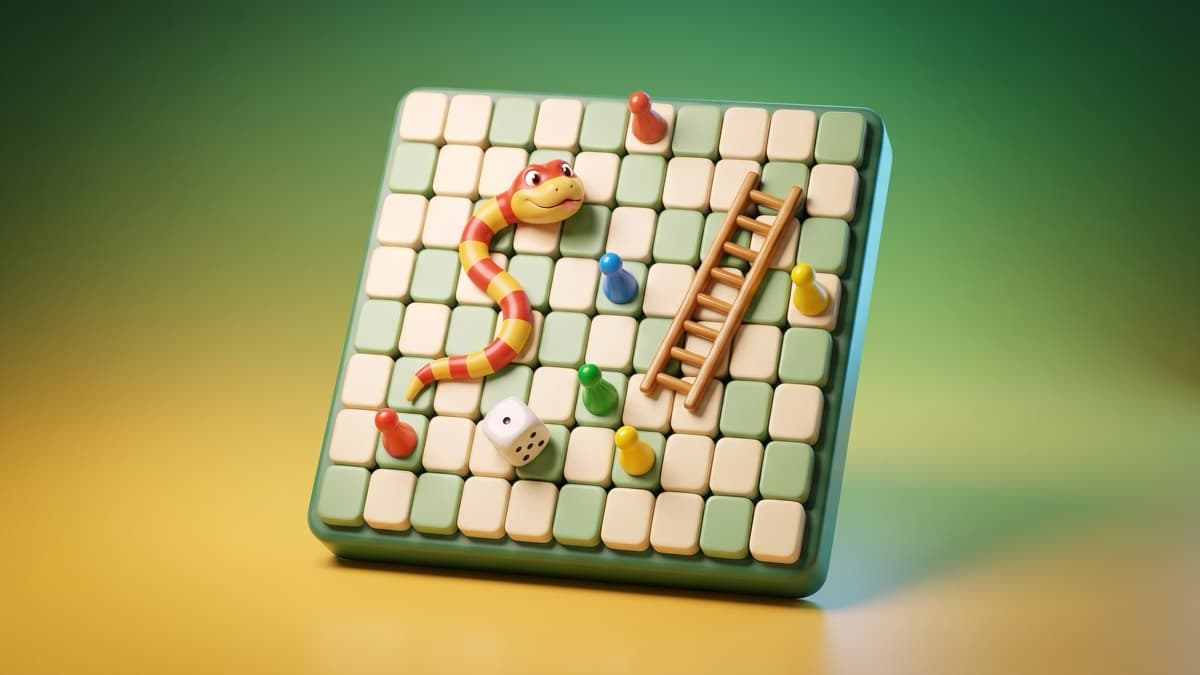
Parlour's version has three illustrated boards to choose from, a garden, desert dunes and a starlit sky, for one to four players: against computer players, passing one device, or face to face around it.


Free on iPhone, iPad and Android. No pop-up ads mid-game. No account needed.
- Players
- 1 to 4 players
- Ways to play
- Against the computer, pass and play on one device, face to face round one device
- Where
- iPhone, iPad and Android
How to play Snakes and Ladders
The board
The board is a grid of 100 squares, numbered from 1 in the bottom corner, snaking back and forth row by row up to 100 at the top. Ladders join some squares to higher ones; snakes join some squares to lower ones. Every player has one token, which starts off the board before square 1.
A turn
Roll the die and move your token forward that many squares, following the numbers. If you finish your move at the foot of a ladder, climb straight up to the square at its top. If you finish on a snake's head, slide all the way down to its tail. Only the square you land on counts: passing over a snake or a ladder on the way does nothing.
Rolling a 6
In Parlour's standard rules a 6 gives you another roll after your move, so a lucky player can cover a lot of ground in one turn. Some families play without the extra roll, and you can switch it off in setup.
Finishing
The first player to land on square 100 wins. You need the exact number to get there. With the standard rule, a roll that is too high takes you to 100 and bounces you back by the extra squares, which can land you on a snake near the top. The other common rule is to stay put until you roll the right number, and Parlour offers that too.
Playing with children
Snakes and Ladders is pure luck: there are no decisions to make, so younger players can beat adults fairly. That makes it a good first game for learning to count squares, take turns and lose cheerfully.
- Let them count. Moving the token square by square is half the fun for small children, and good counting practice.
- Talk about the board. Before you start, spot the longest ladder and the longest snake together, and see who lands on them.
- Keep games short. A game usually takes a few minutes. Play best of three if one round ends in tears.
- Try the other boards. The snakes and ladders sit in different places on each board, so each one plays a little differently.
What's special in Parlour
- One to four players: computer players fill any empty seats and simply roll their dice, because the game is all luck.
- Pass and play on one device, or face to face with the device flat on the table.
- Three illustrated boards, Garden, Desert dunes and Starlight, and options for rolling a 6 again and for overshooting 100.
- A guided first game that shows climbing, sliding and finishing.
- Gems you earn by playing pay for new looks across Parlour. Nothing bought with gems changes a dice roll.
Common questions
- Do you have to land exactly on 100?
- Yes. By default an overshoot bounces you back by the extra squares. You can switch to staying put until you roll the exact number.
- Can children play Snakes and Ladders in Parlour?
- Yes. Parlour is made for all ages, and on iPhone and iPad, Kid mode for players under 13 turns off ads and purchases (on Android it is a parent-controlled switch with child-directed ads). Snakes and Ladders needs no reading or strategy, so young children can play adults on equal terms.
- Is Snakes and Ladders free?
- Yes. Parlour is free to download, with no pop-up ads mid-game. Ads show between games, and a one-time purchase removes them.
- Is Snakes and Ladders on Android?
- Yes. Snakes and Ladders is in Parlour on Google Play as well as the App Store, for one to four players passing one device or sitting round it.