How to play backgammon: rules, setup and strategy
Each player races 15 checkers round the board, into their home board and off. Two dice decide every move, a lone checker can be hit and sent back, and the first player to bear off all 15 wins.
By our team. Published . 3 sources.
Backgammon is a race for two players. Each player has 15 checkers on a board of 24 narrow triangles called points, and moves them in opposite directions according to two dice. You bring all 15 checkers into your home board (the last six points), then remove them from the board, which is called bearing off. The first player to bear off all 15 wins [1] [2].
Along the way, a checker standing alone on a point (a blot) can be hit by an opposing checker and sent back to the start, and two or more checkers on a point block it completely. That mix of racing, blocking and hitting is the whole game.
The board and the point numbers
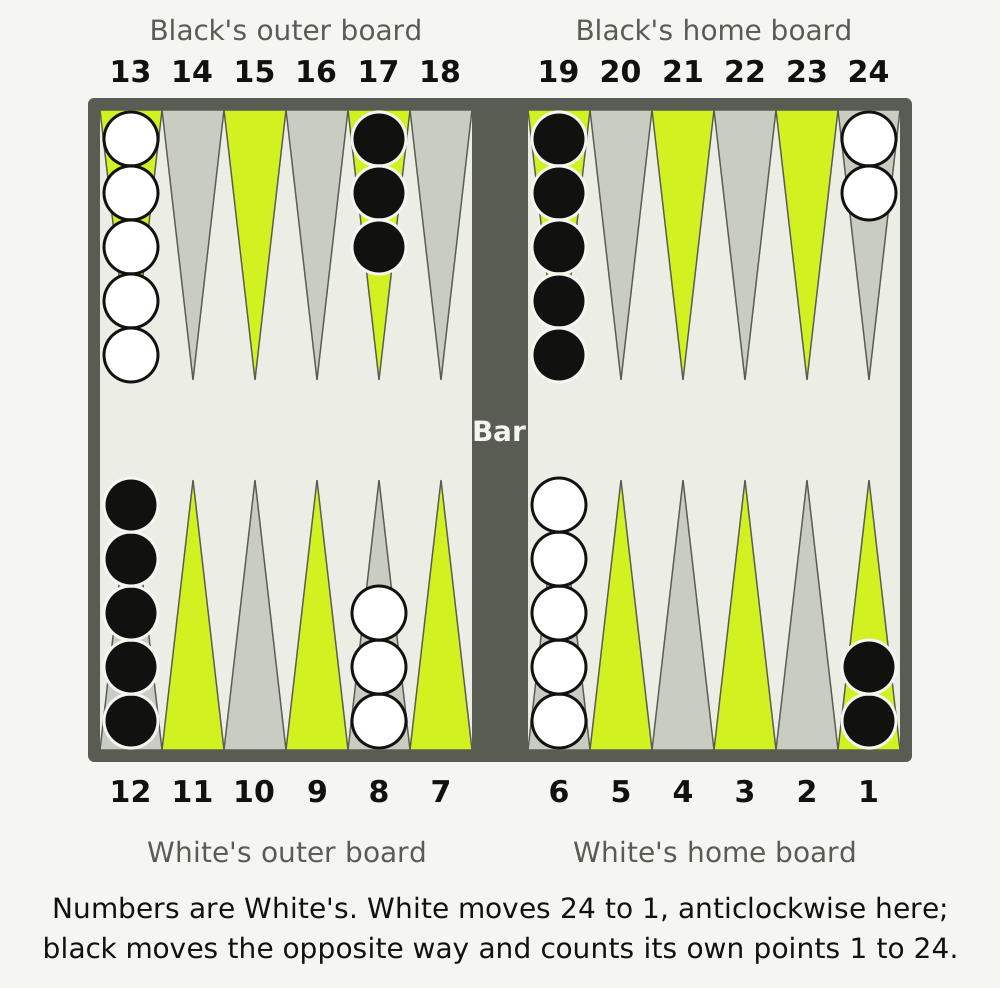
The board has four quarters of six points each, with a raised strip called the bar down the middle. Each player numbers the points from 1 to 24 starting in their own home board, so your 1-point is your opponent's 24-point, and your 13-point is their 12-point [2]. You always move your checkers from higher numbers to lower numbers, from your 24-point round to your 1-point and then off [1].
Your home board (points 1 to 6) and your outer board (7 to 12) are on your side of the table; your opponent's outer and home boards are opposite. Whether your home board is on your right or left does not matter, as long as the two home boards face each other; in the diagram, White's home board is on the right.
Setting up the board
Each player places 15 checkers like this, counting the points from their own side [1] [2]:
- Two checkers on your 24-point (in your opponent's home board, at the end furthest from the bar).
- Five checkers on your 13-point (in your opponent's outer board, at the end furthest from the bar).
- Three checkers on your 8-point (in your outer board, next but one to the bar).
- Five checkers on your 6-point (in your home board, next to the bar).
- Check it: 2 + 5 + 3 + 5 = 15. Your opponent's checkers sit on the same points counted from their side, so their 6-point stack faces your 19-point and their 13-point stack faces your 12-point.
Each player also has a pair of dice and a shaker, and there is one doubling cube, which starts in the middle with 64 face up (it counts as 1 until somebody doubles).
Starting the game
Each player rolls one die. The higher number moves first, using the two numbers just rolled as their first move. If both dice show the same number, roll again [1]. After that, players take turns rolling both dice.
Moving your checkers
- Each die is a separate move. With a 5 and a 3, you move one checker 5 points and one checker 3 points, or one checker 5 and then 3 (8 points in total) [1].
- You can land only on an open point: one that is empty, has your own checkers on it, or has a single opposing checker. A point holding two or more opposing checkers is blocked [1].
- When one checker uses both dice, the point it stops on after the first die must be open too [1].
- Doubles count twice. Roll two 4s and you move four times 4, in any combination of checkers [1].
- You must use the whole roll if you can. If you can play both numbers, you must. If you can play only one, you play that one, and if you could play either but not both, you must play the larger. If neither can be played, you lose your turn [1].
Hitting and the bar
If you land on a point with a single opposing checker on it, you hit it: that checker goes onto the bar [1].
A player with a checker on the bar must bring it back in before moving anything else. It enters in the opponent's home board, on the point matching one of the dice: a 1 enters on the opponent's home board point furthest from the bar (your 24-point), a 6 on the point next to the bar (your 19-point). It can enter only on an open point. If neither die gives an open point, the whole turn is lost [1] [2].
A blot can be hit by a checker any distance away if the dice allow, but blots close to opposing checkers are easiest to hit. A checker 6 or fewer points away can be hit by a single die; one further away needs both dice combined.
Bearing off
Once all 15 of your checkers are in your home board, you can start removing them [1]:
- Roll a number and remove a checker from the matching point: a 4 removes a checker from your 4-point.
- You can also use a roll to move a checker within your home board instead.
- If there is no checker on the matching point, you must make a legal move using a checker on a higher point.
- If there are no checkers on higher points, you remove a checker from the highest point that has one. For example, with checkers only on your 3-point and 1-point, a 5 bears off from the 3-point.
If one of your checkers is hit while you are bearing off, it has to travel all the way back round to your home board before you bear off again [1].
Winning: single game, gammon and backgammon
The first player to bear off all 15 checkers wins. How much they win depends on how far behind the loser is [1] [2]:
| Result | What the loser has done | Points won (times the cube) |
|---|---|---|
| Single game | Borne off at least one checker | 1 |
| Gammon | Borne off no checkers | 2 |
| Backgammon | Borne off none and still has a checker on the bar or in the winner's home board | 3 |
The doubling cube
The doubling cube is what turns a single game into a contest of judgement. It is marked 2, 4, 8, 16, 32 and 64, and multiplies the value of the game [1] [2].
- At the start of your turn, before you roll, you may offer to double the stakes.
- Your opponent then chooses: drop (refuse), conceding the game at its current value, or take, carrying on at double the value.
- The player who takes now owns the cube and puts it on their side. Only they can make the next double (a redouble), and when they do, the cube passes back across [1].
- There is no limit to the number of redoubles in a game [1].
Simple arithmetic gives a rough guide. Dropping costs the current stake for certain, while taking risks twice that to win twice that, so a take is right if you expect to win more than about one game in four from that position, before allowing for gammons.
Common extra rules
- Crawford rule (match play). In a match to a set number of points, as soon as one player is one point away from winning, the next game is played with no doubling. Doubling is allowed again after that game.
- Jacoby rule (money play). Gammons and backgammons count only as single games unless the cube has been turned during that game [1].
- Beavers. A player who is doubled may immediately redouble while keeping the cube on their side [1].
- Automatic doubles. If both players roll the same number for the first move, the cube is turned to 2 and stays in the middle, usually once per game [1].
These are optional: agree them before you start.
The best opening moves
Computer rollouts have settled the best way to play nearly every opening roll. Notation such as 8/5 6/5 means one checker from the 8-point to the 5-point and one from the 6-point to the 5-point [3].
| Roll | Best play | Why |
|---|---|---|
| 3-1 | 8/5 6/5 | Makes your 5-point, the most valuable point on the board |
| 4-2 | 8/4 6/4 | Makes your 4-point |
| 6-1 | 13/7 8/7 | Makes your 7-point (the bar point) |
| 5-3 | 8/3 6/3 | Makes your 3-point |
| 6-5 | 24/13 | Runs a back checker all the way to safety |
| 6-4 | 24/18 13/9, 24/14 or 8/2 6/2 | Three plays score almost the same |
| 6-3 | 24/18 13/10 | Splits the back checkers and brings a builder down |
| 6-2 | 24/18 13/11 | Same idea |
| 5-4 | 24/20 13/8 | 13/9 13/8 is almost as good |
| 5-2 | 24/22 13/8 | 13/11 13/8 is close |
| 5-1 | 24/23 13/8 | 13/8 6/5 is close |
| 4-3 | 13/10 13/9 | 24/21 13/9 and 24/20 13/10 are close |
| 4-1 | 24/23 13/9 | 13/9 6/5 is close |
| 3-2 | 13/11 13/10 | 24/21 13/11 is equally good |
| 2-1 | 13/11 6/5 | 24/23 13/11 is the safer choice |
The first player cannot open with a double, because the opening roll uses one die from each player. For doubles later in the game, the same ideas apply: make points in your home board and on your bar point.
Strategy for your first games
- Make points, especially your 5-point, 4-point and bar point. Points in front of your opponent's back checkers block their escape.
- Don't leave blots in range without a reason. Before you finish a move, look for any single checker within 6 points in front of an opposing checker.
- Build a prime. Six points in a row is a wall no checker can pass.
- Count the race. Add up the points each player still needs to move (the pip count). Each side starts at 167. If you are well ahead, stop hitting and blocking and just race home safely.
- Get your back checkers moving early. Two checkers left on your 24-point late in the game are easy to trap.
- Use the cube. Double when you are clearly ahead but not yet so far ahead that your opponent will simply drop.
Common questions
- Which way do the checkers move in backgammon?
- Each player moves from their 24-point towards their 1-point, so the two sides move in opposite directions, in a horseshoe shape round the board. Your home board is where your checkers finish [1].
- Do you have to use both dice in backgammon?
- Yes, if you legally can. If only one number can be played, you play it; if either could be played but not both, you must play the larger one [1].
- What happens when you roll a double?
- You play the number four times instead of twice. A roll of two 3s lets you move 3 points four times, with one checker or several [1].
- Can you bear off with a higher number?
- Only when there are no checkers on higher points. If you roll a 6 and your highest checker is on your 4-point, you can bear it off; if you have a checker on your 6-point, you must use that [1].
- What is a gammon in backgammon?
- A win in which the loser has not borne off any checkers. It scores double. If the loser also still has a checker on the bar or in the winner's home board, it is a backgammon and scores triple [1] [2].
- Do you need the doubling cube to play?
- No. Beginners often play without it, and every game is then worth 1, 2 or 3 points. The cube adds a decision about stakes before each roll.
- What does the 64 on the doubling cube mean?
- Cubes have no face for 1, so the cube starts with 64 showing in the middle, meaning nobody has doubled yet and the game is worth 1.
Sources
Checked on 5 November 2026.
- 1.Backgammon Galore, "Rules of Backgammon": https://www.bkgm.com/rules.html
- 2.US Backgammon Federation, "Backgammon basics: how to play": https://usbgf.org/backgammon-basics-how-to-play/
- 3.Backgammon Galore, "Opening rolls" (rollout results): https://bkgm.com/openings.html