How to play carrom: board rules, the queen and scoring
Flick the striker from your baseline to pocket your nine coins before your opponent pockets theirs. Pocket and cover the red queen on the way for 3 extra points. Games run to 25 points under the international laws.
By our team. Published . 3 sources.
In carrom, you flick a heavy disc, the striker, from your baseline to knock your own coins into the four corner pockets. One player has the nine white coins and the other the nine black. The player who breaks plays white. Pocket one of your coins and you shoot again. The red queen can be pocketed once you have pocketed a coin of your own, and you must then cover it by pocketing another of your coins. The first to clear all nine wins the board and scores a point for each coin the opponent has left, plus 3 for the queen. Under the international laws, a game goes to 25 points or eight boards [1].
The game comes from India, and the International Carrom Federation (ICF), formed in Chennai in 1988, publishes the Laws of Carrom used in tournaments [3]. Home games often run on simpler or local rules. This page follows the ICF laws and points out where house rules commonly differ.
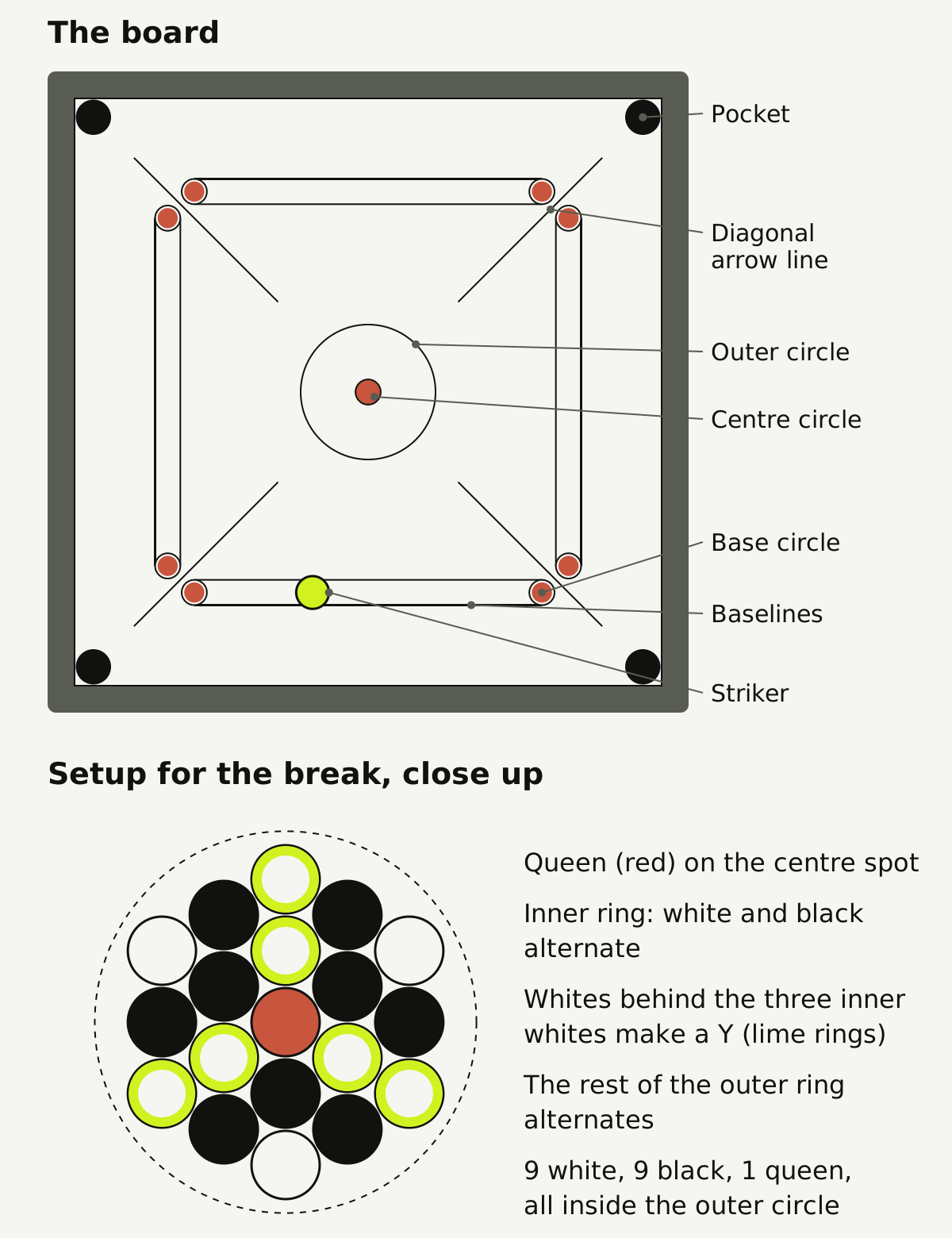
The board and pieces
| Item | International specification |
|---|---|
| Playing surface | 73.5 to 74 cm square [2] |
| Pockets | Four, in the corners, 4.45 cm across [2] |
| Baselines | Two parallel lines on each side, 47 cm long, closed by a base circle at each end [2] |
| Centre circle | 3.18 cm across, where the queen starts [2] |
| Outer circle | 17 cm across; the coins are set up inside it [2] |
| Coins (carrommen) | 9 white, 9 black and 1 red queen, 3.02 to 3.18 cm across [1] |
| Striker | Up to 4.13 cm across and 15 g [1] |
Each player owns the pair of baselines in front of them. The diagonal arrow lines pointing at the pockets matter for one rule: your elbow must not cross the line made by extending the arrows on your side [1].
Players
- Singles: two players sitting opposite each other [1].
- Doubles: four players, with partners sitting opposite. Turns pass to the right [1].
Setting up
- Put the queen on the centre circle.
- Place six coins round it, touching it, alternating white and black.
- Put a white coin directly behind each of the three inner whites, so the whites make a Y shape out from the queen.
- Fill the rest of the outer ring, alternating white and black. All 19 pieces sit touching each other inside the outer circle [1].
- Toss a coin. The winner chooses either a side or the break. If they choose to break, the other player chooses sides [1].
- Whoever breaks plays white for that board. In a game, the break alternates board by board [1].
Striking
- Place the striker on your baseline. It must touch both lines. If you use a base circle, the striker must cover it completely, and it must not touch the arrow [1].
- Flick the striker with a finger. It must be struck, not pushed, and you can use either hand [1].
- Only your hand may go past the extended arrow lines. Your elbow and body stay behind them [1].
- The break: the striker must touch at least one coin. You get three attempts. If all three miss, your opponent breaks and plays black [1].
- Your turn continues as long as you legally pocket your own coins or the queen. When you pocket nothing, the turn passes [1].
- Pocketing an opponent's coin is not a foul. It stays pocketed, which helps them, and your turn ends [1].
The queen
The queen is worth 3 points to the winner of the board, but only if they pocket it and cover it.
- You can pocket the queen only after you have pocketed at least one of your own coins. If you pocket it earlier, it goes back to the centre and your turn ends [1].
- Covering: after pocketing the queen, you must pocket one of your own coins on the same stroke or the very next one. If you do, the queen is yours. If you don't, the queen goes back on the centre circle [1].
- The queen must be pocketed and covered before your last coin. Pocketing your last coin while the queen is still on the board loses you the board, and your opponent scores 3 [1].
Fouls and dues
A due is a penalty coin. One of your pocketed coins comes out and your opponent places it anywhere inside the outer circle [1].
| What happened | Penalty under the ICF laws |
|---|---|
| Striker pocketed on its own | You lose your turn and owe one coin [1] |
| Striker pocketed with one or more of your coins | Those coins and one more come back, but you keep your turn [1] |
| Striker pocketed with the queen | The queen goes back to the centre and you owe one coin, but you keep your turn [1] |
| Any other foul during your turn (touching pieces, pushing, crossing the arrow line) | You owe one coin and lose your turn. Coins pocketed on that stroke also come back [1] |
| A due before you have pocketed anything | It stays owed and comes out as soon as you pocket a coin [1] |
| Pocketing your opponent's last coin | You lose the board [1] |
If the striker jumps off the board but you pocketed your own coin on that stroke, your turn continues [1].
Scoring
When a player has pocketed all nine of their coins, they win the board.
- They score 1 point for each of the opponent's coins still on the board [1].
- They score 3 more for the queen if they covered it. The player who loses the board never gets the queen's points, even if they covered it [1].
- Once you reach 22 points, the queen scores nothing more for you [1].
- A board is worth at most 12 points, and any outstanding dues are written off at the end [1].
A game goes to 25 points or eight boards, whichever comes first. If it is still tied after eight boards in early rounds, one extra board decides it. A match is the best of three games [1]. You may see 29 points quoted for older or local rules. The ICF laws we checked say 25.
Common house rules
- Queen any time: many home games let you pocket the queen before your first coin.
- Simpler fouls: some players count only a pocketed striker as a foul, with one coin back.
- Family scoring: in one casual points version, a black coin typically scores 10 and a white 20 [3].
Tips
- Powder the board lightly. The ICF laws ask for even powder, neither too much nor too little [1]. A sticky board ruins every shot.
- Learn the straight shot first. Line up the striker, coin and pocket, and strike the centre of the striker.
- Use rebounds. A coin near your own baseline is often easier to cut in off the cushion than to hit head on.
- Leave the opponent nothing. If you cannot pocket, push coins of theirs towards the middle and away from the pockets.
- Cover in the same shot when you can. Pocketing the queen and one of your coins together counts as covered [1].
If you have no board, you can practise aim and the queen rule against the computer in our app Parlour.
Common questions
- Who plays white in carrom?
- The player who breaks plays white for that board, and the opponent plays black [1]. The right to break alternates from board to board.
- Can you pocket the queen first in carrom?
- Not under the ICF laws. You must have pocketed at least one of your own coins first. If you pocket the queen earlier, it goes back to the centre and your turn ends [1]. Many home games relax this.
- What does covering the queen mean?
- After pocketing the queen, you must pocket one of your own coins on the same stroke or the next one. That is covering. If you fail, the queen returns to the centre circle [1].
- What happens if you pocket the striker in carrom?
- You lose your turn and one of your pocketed coins comes back as a due, placed by your opponent inside the outer circle. If you pocketed your own coins on the same stroke, they come back as well, but you keep your turn [1].
- How many points is the queen worth in carrom?
- 3 points, credited only to the player who wins the board having covered it, and only until that player reaches 22 points [1].
- How many points is a game of carrom?
- Under the ICF laws a game is 25 points or eight boards, whichever comes first, and a match is the best of three games [1].
- Can four people play carrom?
- Yes. Doubles is played by two pairs, with partners sitting opposite each other and turns passing to the right [1].
Sources
Checked on 5 November 2026.
- 1.Laws of Carrom, International Carrom Federation (copy hosted by the German Carrom Federation): https://www.carrom.de/_files/ugd/944b7d_bdb04c1b32df49fbafc5b649f6e03214.pdf
- 2.Laws of Carrom: standard equipment, carrom.co.uk (adopted by the ICF, 1993): https://www.carrom.co.uk/laws-of-carrom/
- 3.Carrom, Wikipedia: https://en.wikipedia.org/wiki/Carrom