How to play mancala: rules, captures and strategy
Pick up all the seeds in one of your six pits and sow them one by one anticlockwise, into your own store as you pass it. Land the last seed in your store to go again, or in an empty pit of yours to capture the seeds opposite. The fuller store wins.
By our team. Published . 3 sources.
Mancala is played on a board of two rows of six pits, with a large store at each end. Put four seeds in each pit. On your turn, pick up every seed in one of your pits and drop them one at a time into the following pits, going anticlockwise. Include your own store but skip your opponent's. If your last seed lands in your store, you take another turn. If it lands in an empty pit on your side, you capture it and all the seeds in the pit opposite. When one side runs out of seeds, the game ends and the player with more seeds in their store wins.
Strictly, mancala is a large family of sowing games, played with two or four rows of pits [1]. The name comes from the Arabic for "to move" [1]. The rules above are the version most people in the UK and US learn first, sold in shops simply as mancala. Oware and Bao, two other well-known members of the family, are described at the end.
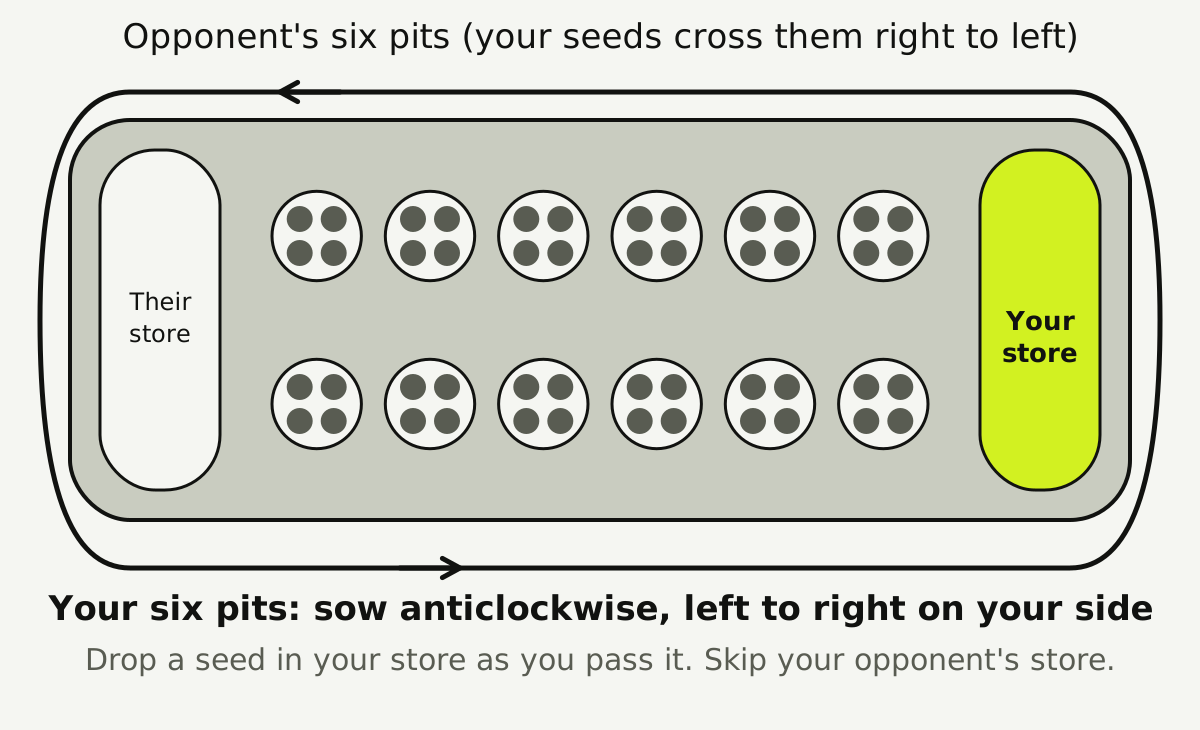
What you need
- A board with two rows of six small pits and a large store at each end. An egg box with two bowls works.
- 48 seeds, stones or beads.
Setting up
- Put the board between the two players, long side towards each of you.
- The six pits nearest you are yours. Your store is the big pit at your right-hand end.
- Put four seeds in each of the twelve pits. Both stores start empty.
- Decide who goes first. If you play several games, the loser of each game usually starts the next.
How to sow
- Choose one of your six pits that has seeds in it.
- Pick up all of its seeds.
- Going anticlockwise (to the right along your own row), drop one seed into each pit in turn.
- When you reach your store, drop one in. Keep going along your opponent's row.
- Never drop a seed into your opponent's store. Skip it and carry on into your own row.
A pit with lots of seeds can go all the way round the board. In this version, the pit you started from gets a seed too when you pass it.
Extra turns
If the last seed you drop lands in your own store, you take another turn straight away. There is no limit. Good players chain several extra turns together.
Capturing
If the last seed you drop lands in an empty pit on your own side, and the pit directly opposite has seeds in it, you capture. Take your last seed and all the seeds from the opposite pit, and put them in your store.
If the opposite pit is empty, nothing is captured in the most common rule, and your seed stays where it is. Some families capture the single seed anyway. A last seed that lands in an empty pit on your opponent's side never captures.
Ending the game and scoring
The game ends as soon as all six pits on one side are empty. The other player moves all the seeds left on their side into their own store. Count the stores. The fuller store wins.
There are 48 seeds, so 25 is a guaranteed win and 24 each is a draw.
Rules on the ending vary. In a common alternative, the game ends only when the player whose turn it is has no seeds to sow, and some families give the leftover seeds to the player who emptied their side. Agree before you start, because it changes the endgame a lot.
Strategy
- Open with an extra turn. At the start, the third pit from your left has exactly four seeds and is four steps from your store. Sow it and you go again.
- Count to your store. A pit that is one step from your store needs one seed to reach it, two steps needs two, and so on. Look for every pit whose seeds exactly match its distance from the store.
- Use the 13-seed trick. A pit with exactly 13 seeds goes all the way round and drops its last seed back into the pit it started from, which is now empty. That is a capture.
- Set up captures. An empty pit on your side, facing a full pit, is a threat. A pit that one of your smaller pits can reach exactly is a capture next turn.
- Defend. Look at your opponent's empty pits and what can reach them. If one of your full pits sits opposite an empty pit they can hit, sow it or fill the gap.
- Think about the end. Seeds on your side when the game ends usually count for you. When you are ahead, keeping seeds in your own pits and running your opponent out of moves can win it.
You can practise these against the computer in our app Parlour.
Other mancala games: Oware and Bao
Oware (also called awalé, wari or awari) is played across West Africa and the Caribbean [2]. It uses the same board of two rows of six pits with four seeds each, but plays very differently:
- Seeds are not sown into the stores. You sow only round the twelve pits, and you skip the starting pit on a long lap.
- You capture when your last seed lands in an opponent's pit and makes it exactly two or three. You also take any unbroken run of two-or-three pits just before it on their side.
- If your opponent has no seeds, you must make a move that gives them some.
- The first to capture 25 seeds wins [2].
A common version of Oware has been solved by computer: with perfect play from both sides, it is a draw [2].
Bao is played in East Africa, especially among the Swahili people of Tanzania and Kenya [3]. Its board has four rows of eight pits, and each player owns the two rows nearest them. Captures take seeds from the opponent's inner row, and captured seeds are sown again, which can set off more captures in one turn. It is widely seen as one of the most complex games in the family [3].
Common questions
- Which way do you go in mancala?
- Anticlockwise. On your own row that means left to right, into your store at your right-hand end, then right to left along your opponent's row.
- Do you put seeds in your opponent's store?
- No. You drop a seed in your own store each time you pass it, but always skip your opponent's.
- When do you get another turn in mancala?
- When the last seed you sow lands in your own store. You can earn several extra turns in a row.
- How do captures work in mancala?
- If your last seed lands in an empty pit on your side and the pit opposite has seeds, you take those seeds and your last seed and put them in your store. Landing in an empty pit on your opponent's side does nothing.
- What happens when one side is empty?
- The game ends. The other player moves all the seeds still on their side into their own store, and the fuller store wins. Some families play that the game ends only when the player to move has nothing to sow.
- How many seeds do you need to win mancala?
- With four seeds in each of twelve pits there are 48 in total, so 25 guarantees a win. 24 each is a draw.
- Is Oware the same as mancala?
- Oware is one game in the mancala family. It uses the same two-by-six board, but captures happen on the opponent's side, when your last seed makes a pit two or three, and the first to 25 wins [2].
Sources
Checked on 5 November 2026.
- 1.Mancala, Wikipedia: https://en.wikipedia.org/wiki/Mancala
- 2.Oware, Wikipedia: https://en.wikipedia.org/wiki/Oware
- 3.Bao (game), Wikipedia: https://en.wikipedia.org/wiki/Bao_(game)