How to play solitaire: Klondike rules, setup and strategy
Klondike, the game most people mean by solitaire (patience in the UK), explained from the deal to the last card: the layout, every legal move, draw one or three, scoring and how to win more deals.
By our team. Published . 3 sources.
Solitaire, properly called Klondike, is a one-player card game in which you sort a shuffled 52-card pack into four piles, one per suit, from ace up to king. You deal 28 cards into seven columns, then free the cards by building the columns down in alternating colours (red on black, black on red) and turning cards from the stock. You win when all 52 cards are on the four foundation piles.
In the UK the same game is usually just called patience [1]. The rules below are the ones almost every card book and computer version share; where versions differ (how many cards you turn, how many times you can go through the stock, how you score) we say so.
What you need
One standard 52-card pack, no jokers, and a table with room for two rows of seven cards.
The layout
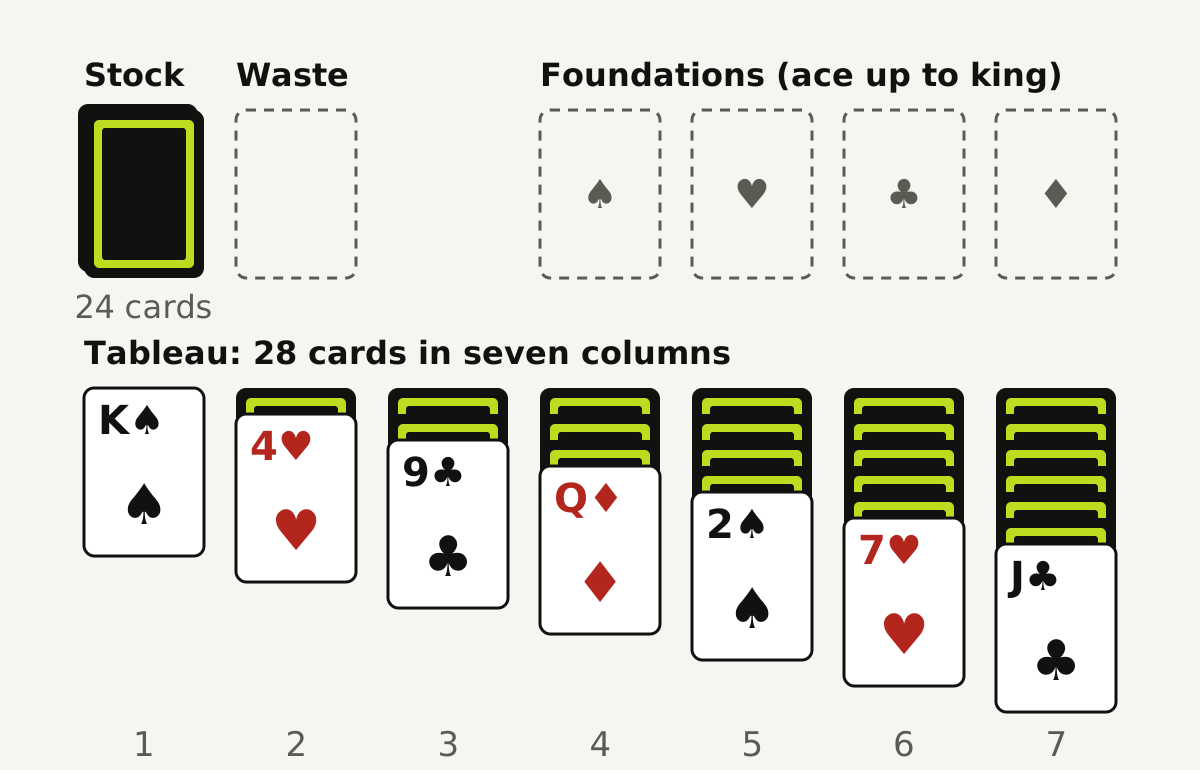
The game has four areas:
- Tableau: the seven columns in the main row, where most of the play happens.
- Foundations: four spaces above the tableau, empty at the start. Each one is built up in a single suit from ace to king.
- Stock: the 24 cards left over after the deal, face down.
- Waste: where cards from the stock are turned face up. Only its top card can be played.
How to deal
- Shuffle the pack.
- Deal a row of seven cards from left to right: the first face up, the other six face down.
- Deal a second row starting on column 2: the card on column 2 face up, the rest face down.
- Keep going, starting one column further right each time, until column 7 gets its seventh card face up.
- You now have columns of 1, 2, 3, 4, 5, 6 and 7 cards (28 in all), each with only its top card face up.
- Put the remaining 24 cards face down above the tableau as the stock.
Dealing row by row rather than one column at a time matters only for tradition; either gives the same shape.
How the cards move
On the tableau, build down in alternating colours. A card can go on a face-up card one rank higher of the opposite colour: a red 6 on a black 7, a black jack on a red queen. Aces are low and kings are high, so nothing goes on an ace in the tableau and a king can only sit at the top of a column.
On the foundations, build up by suit. Each foundation starts with an ace, then takes the 2 of that suit, then the 3, and so on to the king [2]. Aces go to a foundation as soon as you see them, because nothing in the tableau can be built on them.
You can move a run as one unit. Any properly built sequence of face-up cards (say black 9, red 8, black 7) can move together onto a card that would accept its top card, here a red 10. You can also move just the lower part of a run.
Turn up hidden cards. When you move the last face-up card off a column, turn the face-down card beneath it face up. It is now in play.
Only a king fills an empty column. When a column is cleared completely, the space can take a king, or a run with a king at its head, and nothing else [2].
Cards can usually come back off a foundation. Most versions let you move the top card of a foundation back onto the tableau if it fits there. Computer scoring docks points for it [1], but it is sometimes the only way to free a card.
The stock and waste: draw one or draw three
When you have no useful move in the tableau, turn cards from the stock onto the waste. The top waste card can go to a foundation or the tableau; the cards beneath it become available in turn as you play the top one.
There are two common ways to turn the stock:
| Version | What you turn | What it does to the game |
|---|---|---|
| Draw one (turn one) | One card at a time | Every stock card becomes available on every pass. Easier. |
| Draw three (turn three) | Three cards at a time, playing only the top one | Two in three stock cards are hidden on any pass unless you play cards off the waste to shift the order. Harder. |
When the stock runs out, turn the waste over to form a new stock and go through it again. How many times you may do this is where versions differ most. The strict traditional rule is a single pass, one card at a time, and Hoyle puts the odds of winning that way at about 1 in 30 [1]. Common house and computer rules allow three passes or unlimited passes [1]. Agree the rule before you start; on a computer it is usually a setting.
How you win, and when you have lost
You win when all four foundations run from ace to king. You have lost when no card can be moved anywhere and going through the stock again would change nothing. Many deals stall before that point, and recognising a hopeless position early saves time.
Scoring
Plain Klondike needs no score: you either clear the cards or you do not. Two scoring systems come from computer versions.
Standard (Windows) scoring [1]:
| Move | Points |
|---|---|
| Waste to tableau | 5 |
| Waste to foundation | 10 |
| Tableau to foundation | 10 |
| Turning over a tableau card | 5 |
| Foundation back to tableau | minus 15 |
| Turning the waste over in draw one | minus 100 (score never drops below 0) |
Timed games also deduct 2 points every 10 seconds and add a time bonus for a fast finish [1].
Vegas scoring treats each deal as a bet: you pay a fixed stake to play and win back a fixed amount for every card you get onto the foundations [1]. It is usually played with limited passes through the stock, so it rewards getting as many cards up as possible rather than finishing the deal.
Can every deal be won?
No. Some deals are lost before the first move, because the cards you need are buried under the cards that need them. The most careful study so far used a solver that sees every card, including the face-down ones. It found about 82% of deals winnable with draw three and unlimited passes, and about 90% with draw one [3]. Those figures assume perfect knowledge, so a real player, who cannot see the hidden cards, wins fewer.
Strategy that wins more deals
- Turn over hidden cards first. A move that exposes a face-down card is almost always better than one that does not. When you have a choice, work on the column with the most face-down cards, because those cards are the hardest to reach.
- Do not clear a column with no king to fill it. An empty space only takes a king. Clearing one early can be wasted, unless you need it to shuffle cards around.
- Pick your king with an eye on the queens. If a red queen is waiting to come down, fill the space with a black king, and the other way round.
- Do not rush cards to the foundations. Aces and 2s are always safe to play up. A higher card is safe once both cards of the other colour one rank lower are already on the foundations; before that, you may need it in the tableau as a place to put one of them.
- Prefer tableau moves to stock moves. Use the stock when the tableau has nothing productive left, not by habit.
- In draw three, think about the order. The groups of three only change when you play cards off the waste. Playing one waste card early can bring a different card to the top on every later pass.
- Leave yourself choices. When two cards could go to the same place, move the one that turns over a hidden card or frees a longer run.
If you want to practise these ideas without dealing by hand, you can play Klondike against the clock in Parlour, with a hint button that suggests the next productive move.
Common questions
- Is solitaire the same as patience?
- Patience is the British word for any one-player card game, and in the UK the game most people call solitaire, Klondike, is usually just called patience. The rules are the same.
- What is the difference between draw one and draw three?
- In draw one you turn one card from the stock at a time, so every stock card is available on every pass. In draw three you turn three at a time and can only play the top one, so most of the stock stays out of reach unless you play cards off the waste. Draw three is the harder game.
- How many times can you go through the deck?
- It depends on the rules you agree. The strict traditional rule is a single pass, one card at a time. Three passes and unlimited passes are both common house and computer rules, and apps often make it a setting.
- Can you put any card in an empty column?
- No. In Klondike only a king, or a run headed by a king, can fill an empty column. Some other patience games allow any card, which is one way to tell them apart.
- Can you take a card back off the foundation?
- In most versions, yes: the top card of a foundation can move back onto the tableau if it fits there. Windows-style scoring takes 15 points off for doing it.
- Is every game of solitaire winnable?
- No. Even a solver that can see every card wins only about 82% of draw-three deals and about 90% of draw-one deals, and a player who cannot see the face-down cards wins fewer.
Sources
Checked on 5 November 2026.
- 1.Wikipedia, "Klondike (solitaire)" (UK name, pass rules, Windows and Vegas scoring, Hoyle's single-pass odds): https://en.wikipedia.org/wiki/Klondike_(solitaire)
- 2.Bicycle Cards, "Solitaire" rules: https://bicyclecards.com/how-to-play/solitaire
- 3.Blake and Gent, "The Winnability of Klondike Solitaire and Many Other Patience Games" (arXiv, 2019): https://arxiv.org/abs/1906.12314