How to play Spider solitaire: rules, setup and strategy
Spider is a two-pack patience game played in ten columns. You build down in rank, gather eight complete runs from king to ace in one suit, and each finished run leaves the table. Clear all eight to win.
By our team. Published . 2 sources.
Spider is a one-player card game played with two 52-card packs shuffled together. You deal 54 cards into ten columns and keep the other 50 as a stock. You move cards to build each column down in rank, and whenever a column holds a full run from king down to ace in one suit, that run leaves the table. Clear all eight runs and you have won [1].
Spider dates from 1949 [1] and became one of the best-known patience games through computer versions. It is harder than Klondike, the game most people call solitaire, but the difficulty is easy to adjust: play with one suit and most deals can be won; play with all four and good players win about one game in three [1].
What you need
Two standard 52-card packs with no jokers, 104 cards in all, and space for ten columns in a row. To play the easier one-suit or two-suit versions with real cards, see "One, two or four suits" below.
The layout
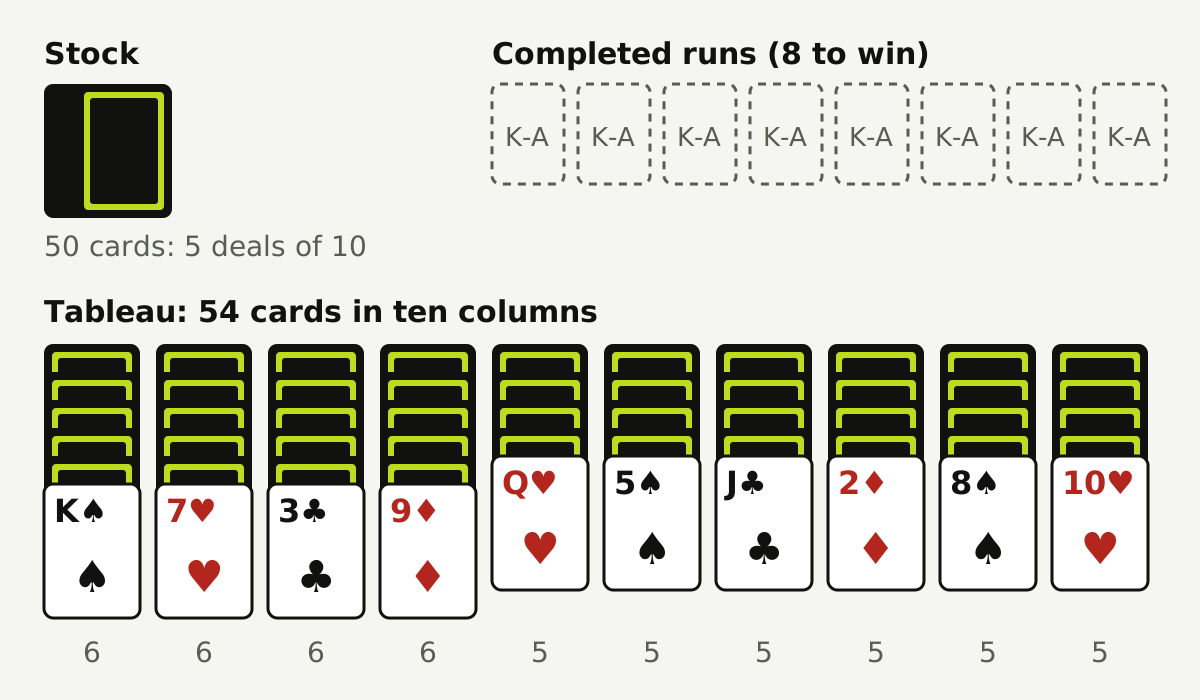
- Shuffle both packs together thoroughly.
- Deal ten columns from left to right. The first four columns get six cards each and the other six columns get five cards each, 54 cards in all [1].
- Every card is dealt face down except the last card of each column, which is turned face up.
- Put the remaining 50 cards face down to one side as the stock. It gives you five more deals of ten cards [1].
There are no foundation piles to build up. Completed runs simply come off the table, and the aim is to remove eight of them.
How to move cards
Only face-up cards can move. There are three kinds of move.
Building down
You can put the bottom face-up card of a column on any card one rank higher, whatever its suit or colour [1][2]. A 6 of clubs can go on any 7, red or black. Aces are low, so nothing goes on an ace, and a king can only move into an empty column.
Moving runs
A group of face-up cards can move together only if it is a run in one suit in descending order, such as 9, 8, 7, 6 of hearts [1][2]. A column showing 9 of hearts, 8 of spades, 7 of hearts is not a run you can move as one: you can move the 7 of hearts on its own, but the 8 and 9 stay where they are until the cards below them have gone.
You do not have to move a whole run. You can split it and move only the lower part, from any card in the run downwards, provided the card it lands on is one rank higher [2].
Turning cards and empty columns
When the last face-up card leaves a column, turn the next face-down card in that column face up [2].
When a column is completely empty, you can move any face-up card, or any movable run, into it [1]. Empty columns are the most valuable thing in Spider, because they give you somewhere to park cards while you rearrange the others.
Dealing from the stock
When you want new cards, or have no useful move left, deal ten cards from the stock, one face up on top of each column [1]. You can deal whenever you like, even when moves are still available, but under the standard rules you cannot deal while any column is empty: fill every space first, with any card or run [1][2].
The new row lands on top of whatever is in each column, often splitting runs you had built. That is why it pays to do as much as you can before each deal.
Completing a run
As soon as a column ends in a full run of thirteen cards in one suit, from king at the top down to ace at the bottom, take the run off the table and put it aside [1][2]. Turn up the card it uncovers, if any. When eight runs are off, the table is clear and you have won.
The game is lost when the stock is empty and no moves you can make will free any more cards.
One, two or four suits
The classic game uses both packs as they come, so there are two cards of every rank in every suit [1]. Computer versions popularised two easier settings, with the same 104 cards [1]:
- One suit: all 104 cards are spades, so every run is in one suit and any group in order can move together. Most deals can be won with care.
- Two suits: 52 spades and 52 hearts. You have to watch suits, but there are far fewer mixed runs than in the full game.
- Four suits: the standard game with two ordinary packs. Mixed-suit stacks build up quickly, and freeing them is the whole challenge.
You can play the easier versions with real cards by taking the spades from four packs (one suit) or the spades and hearts from two packs each (two suits).
Scoring
Spider is often played just to win or lose, but the scoring most computer versions use is simple [1]:
- Start with 500 points.
- Lose 1 point for every move.
- Gain 100 points for every completed run.
So a fast win scores more than a slow one, and a quick win with all eight runs off can score more than 1,000.
Common variations
- Relaxed rules: some versions let you deal from the stock while a column is empty [1]. It makes the game noticeably easier.
- The older deal: some card books deal ten columns of five cards (50 cards), leaving 54 in the stock, so the last deal puts four cards on the first four columns only [2]. The play is otherwise the same.
- Spiderette: a one-pack version dealt in seven columns of 1 to 7 cards, like Klondike, with the same moving and building rules [1].
Strategy: how to win more Spider games
Before the first move
Look at the whole table before you touch anything. Count how many moves each face-up card has and which columns are short; a column with only five cards is closer to being emptied than one with six.
Build in suit whenever you can
Building down in any suit is legal, but only same-suit runs can move together later. When you have a choice, put a 7 of hearts on the 8 of hearts rather than the 8 of clubs. A mixed stack is not a mistake, but every change of suit is a join you will have to undo card by card.
Turn over face-down cards
Every move that turns a card face up gives you new information and new options. Prefer moves that uncover a card over moves that only shuffle face-up cards around.
Empty a column, then use it carefully
An empty column is your best tool. Aim to empty one early, usually the column with the fewest cards. Then use it as a temporary space: move a mixed stack through it a piece at a time, or park a card to reach the card underneath, and try to keep it empty for as long as you can rather than dropping a king in at the first chance.
Do everything before you deal
A deal buries every column under a new card. Before dealing, make every useful move, sort as many runs into suit as you can, and fill your empty columns with the cards you least mind covering, since you must fill them anyway.
Kings and aces
A king can only ever sit on an empty column, so a king high in a column blocks the cards beneath it until you have a space. An ace ends a run, so nothing can be built on it; get aces into place under their own 2 when you can.
Use undo, if you have it
On a computer, Spider rewards trying a line of play, undoing it and trying another. In the four-suit game even strong players lose many deals [1], so a loss is not always a mistake.
Common questions
- How many cards are dealt in Spider solitaire?
- 54 of the 104 cards: six in each of the first four columns and five in each of the other six, with only the top card of each column face up. The other 50 are the stock, dealt ten at a time [1].
- Can you put any card in an empty column in Spider?
- Yes. Any face-up card, or any run in one suit, can move into an empty column [1]. You are not limited to kings.
- Can you deal from the stock with an empty column?
- Not under the standard rules: every column must have at least one card before you deal [1][2]. Some computer versions relax this rule, which makes the game easier.
- Do you have to build in the same suit in Spider?
- No. Any card can go on a card one rank higher, whatever the suit. But only cards in one suit and in order can move together, and only a king-to-ace run of one suit comes off the table, so building in suit pays [1].
- What is the difference between one, two and four suit Spider?
- All three use 104 cards. One suit uses only spades, two suits uses spades and hearts, and four suits is the full game with two ordinary packs [1]. The more suits, the harder it is to build movable runs.
- Is every game of Spider solitaire winnable?
- No. With four suits, good players win about one game in three according to Hoyle [1]. One-suit games can be won much more often.
Sources
Checked on 8 November 2026.
- 1.Wikipedia, "Spider (solitaire)" (deal, rules, suit variants, scoring and odds): https://en.wikipedia.org/wiki/Spider_(solitaire)
- 2.Bicycle Cards, "Spider Solitaire" (moving groups, filling spaces before a deal, the 50-card deal): https://bicyclecards.com/how-to-play/spider-solitaire