How to play checkers: draughts rules, setup and kings
Checkers, called draughts in the UK, is played with 12 pieces each on the dark squares of an 8x8 board. Pieces move diagonally forward, captures are compulsory, and you win by taking or blocking every enemy piece.
By our team. Published . 3 sources.
Checkers is played by two players on an 8x8 board, using only the 32 dark squares. Each player has 12 pieces. Pieces move one square diagonally forward, capture by jumping over an enemy piece, and become kings when they reach the far side. If you can capture, you must. You win when your opponent cannot move, either because all their pieces are gone or because every one is blocked [1].
The game is called checkers in the US and Canada and draughts in the UK and Ireland. This page covers the 8x8 game that both names usually mean, known to its players as English draughts or American checkers, using the official rules of the World Checkers Draughts Federation (WCDF) [1]. Most other countries play different draughts games, and the main differences are at the end.
Setting up the board
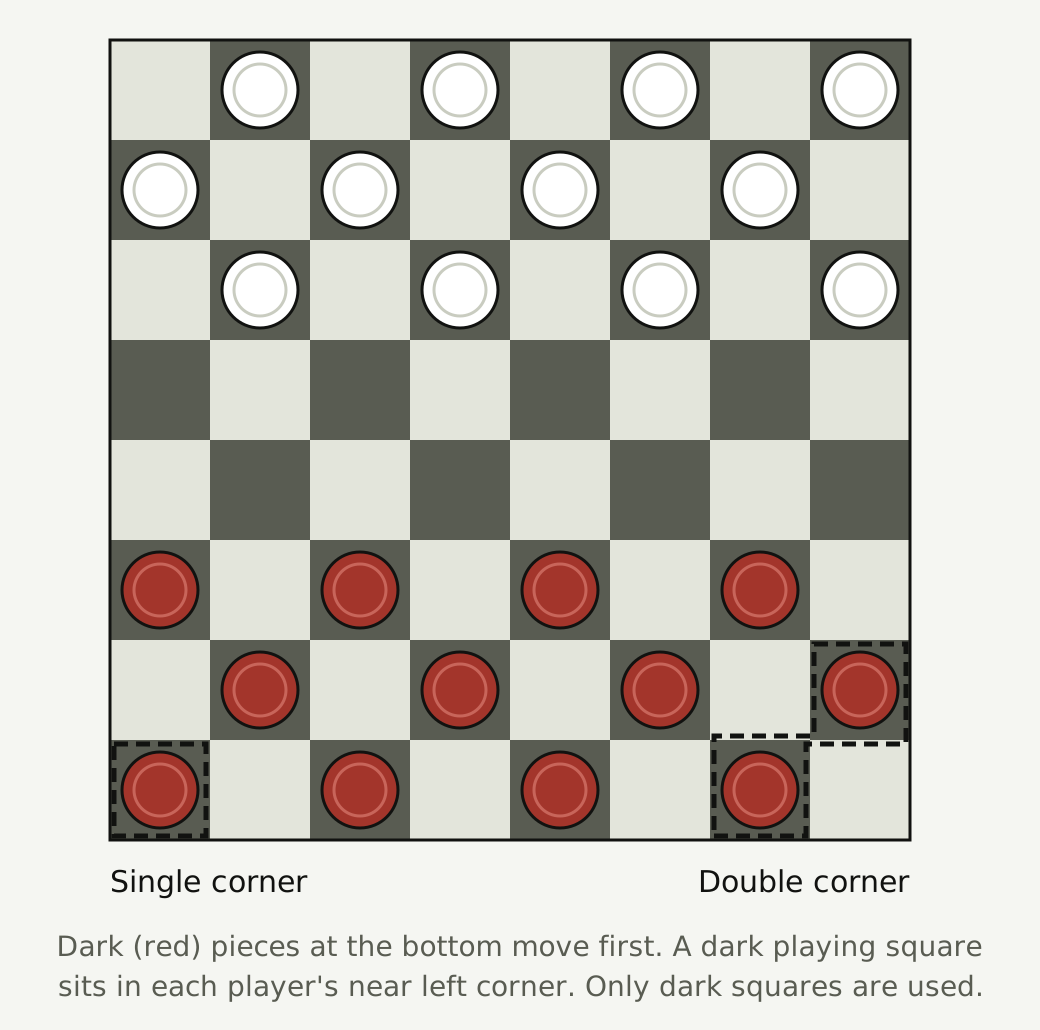
- Place the board so that each player has a dark playing square in the near left-hand corner and a light square in the near right-hand corner [1]. The lone dark square on your left is your single corner; the two dark squares meeting on your right are your double corner.
- Each player puts their 12 pieces on the dark squares of the three rows nearest to them [1].
- Leave the two middle rows empty.
- Decide colours at random for the first game, then swap colours each game [1].
In official play the board is green and white and the pieces are red and white; older books call the dark side Black [1]. Any board works as long as you play on the dark squares.
Who moves first
The dark side moves first: red in an official red and white set [1], and the darker colour in any other set, which is black in the common red and black sets. Some home rulebooks say red always starts; if you are unsure, agree before the game.
How the pieces move
Ordinary moves. An uncrowned piece (a man) moves one square diagonally forward, to the left or right, onto an empty dark square. Men never move backwards [1].
Capturing. If an enemy piece sits on a diagonally adjacent square and the square directly beyond it is empty, you capture by jumping over it into that empty square. The jumped piece is removed. Men can only jump forwards [1].
Captures are compulsory. If any of your pieces can make a capture, you must capture on that turn, even if it walks into a trap [1]. When you have more than one capture available, you may choose any of them; you do not have to take the one that captures the most pieces [1].
Multiple jumps. If, after a jump, the same piece can jump again, it must keep jumping in the same turn until no more jumps are possible. The jumps can change direction along the way, and all the captured pieces are removed at the end of the sequence [1].
The old "huffing" rule, where a piece that failed to capture was removed from the board, is no longer part of the official game. Under the WCDF rules a missed capture is an illegal move: the move is taken back and the player is cautioned [1].
Kings
When a man reaches the far row (the king row), it is crowned: put a second piece of the same colour on top of it. Crowning ends the turn, even if the new king could jump again straight away; it must wait for your next turn [1].
A king moves one square diagonally in any direction, forwards or backwards, and captures forwards or backwards. In English draughts kings move only one square at a time (they do not "fly" along diagonals as they do in international draughts) [1].
Winning and drawing
You win when your opponent has no legal move on their turn, either because all their pieces have been captured or because the ones left are all blocked. You also win if your opponent resigns or runs out of time [1]. A position where you cannot move is a loss, not a draw.
A game is drawn by agreement, or when a player shows that their next move will repeat the same position for the third time, or when 40 moves have passed on each side without any man advancing and without any capture [1]. In casual play, two lone kings chasing each other is the usual draw: if neither side can force a win, agree it and start the next game.
Rules for tournament play
- Touch-move. If you touch one of your pieces on your turn, you must move that piece, unless you warned your opponent you were adjusting it [1].
- Illegal moves. An illegal move, such as a missed capture or moving a man backwards, gets a caution the first time and loses the game the second time [1].
- Opening ballots. Expert games are so often drawn that tournaments start each game from a randomly drawn opening, usually the first three moves (the "three-move ballot"), and the two players then play it once with each colour [3].
Strategy for beginners
- Keep your back row. While your king row is guarded, your opponent cannot crown. Many players keep two back pieces in place for as long as they can.
- Take the centre. Pieces in the middle of the board have two forward moves; pieces on the side have one.
- Move in groups. A piece with a friend behind it on the diagonal cannot be jumped from that side.
- Use forced captures against your opponent. Because capture is compulsory, you can offer one piece to drag an enemy piece into a square where you then jump two.
- Trade when you are ahead. One-for-one exchanges help the side with more pieces.
- Count moves in the endgame. Two kings against one is a win, but you need to drive the lone king out of the double corner, where it can shuttle between two squares.
Draughts in other countries
Most of the world plays draughts with different rules, so check which game your opponent means [2]:
| Game | Board and pieces | Main differences from English draughts |
|---|---|---|
| International draughts | 10x10, 20 each | White moves first. Men capture backwards as well as forwards. Kings fly any distance along a diagonal. You must take the sequence that captures the most pieces. |
| Russian draughts | 8x8, 12 each | White moves first. Men capture backwards and kings fly. You may choose any capture sequence. |
| Brazilian draughts | 8x8, 12 each | International draughts rules on an 8x8 board, including the rule to capture the most pieces. |
| Pool checkers (US) | 8x8, 12 each | Black moves first. Men capture backwards and kings fly. You may choose any capture sequence. |
| Spanish draughts | 8x8, 12 each | White moves first. Kings fly, but men capture only forwards. You must capture the most pieces. |
| Italian draughts | 8x8, 12 each | White moves first. Kings do not fly and men capture only forwards. You must capture the most pieces. |
| Turkish draughts | 8x8, 16 each | Pieces move straight forwards and sideways rather than diagonally, on every square. Kings fly. |
If you learned "checkers" in Europe or Russia, the two rules most likely to surprise you in English draughts are that kings move only one square and that men cannot capture backwards.
Common questions
- Do you have to jump in checkers?
- Yes. Under the official rules, if any of your pieces can capture, you must capture. If you have more than one capture, you may choose which to make, and once you start a multiple jump you must finish it [1].
- Who goes first in checkers, red or black?
- The darker side moves first. In the official red and white set that is red [1]; in a red and black set it is usually black. Agree before you start if your set's instructions say otherwise.
- Can a regular piece move backwards in checkers?
- No. In English draughts and American checkers, men move and capture only forwards. Only kings move and capture backwards [1]. In international and Russian draughts, men may capture backwards.
- Can a king jump again on the turn it is crowned?
- No. Reaching the king row ends the turn, even in the middle of a multiple jump. The new king moves on your next turn [1].
- Can a king move more than one square?
- Not in English draughts or American checkers: a king moves one square diagonally in any direction. Flying kings, which move any distance, belong to international, Russian and several other forms of draughts [1] [2].
- What happens if you cannot move in checkers?
- You lose. A player with no legal move on their turn, whether their pieces are all captured or all blocked, has lost the game [1].
- Are checkers and draughts the same game?
- In the UK and North America, yes: draughts and checkers both mean the 8x8 game on this page. Elsewhere, draughts often means a different game, such as 10x10 international draughts [2].
Sources
Checked on 5 November 2026.
- 1.World Checkers Draughts Federation, "Rules of Draughts (Checkers)": https://www.wcdf.net/rules/rules_of_checkers_english.pdf
- 2.Wikipedia, "Checkers" (variants of draughts): https://en.wikipedia.org/wiki/Checkers
- 3.Wikipedia, "English draughts" (opening restrictions): https://en.wikipedia.org/wiki/English_draughts