How to play sudoku: the rules and the techniques that solve it
The sudoku rule takes one sentence. This guide spends the rest of its time on how to actually solve one: scanning, singles, pencil marks and pairs, each with a worked example.
By our team. Published . 5 sources.
Sudoku has one rule: fill the empty squares of a 9 by 9 grid so that every row, every column and every 3 by 3 box contains each number from 1 to 9 exactly once [1]. Some numbers are printed at the start, and those never change. There is no arithmetic involved; the numbers could just as well be nine letters or nine colours.
A well-made puzzle has exactly one answer, and you can reach it by logic alone, without guessing. The fewest clues such a puzzle can have is 17 [5]. The rest of this guide is about that logic: how to find the next number, from the first easy placements to the techniques that crack harder grids.
The words you will meet
| Term | Meaning |
|---|---|
| Cell or square | One of the 81 small squares. |
| Row, column | A line of nine cells across or down. Rows are numbered from the top, columns from the left. |
| Box | One of the nine 3 by 3 blocks marked by thick lines. Also called a block or region. |
| Unit | Any row, column or box. Every unit must end up holding 1 to 9 once. |
| Givens or clues | The numbers printed at the start. |
| Candidates | The numbers a cell could still be, given what is already placed. Written small in the cell, they are called pencil marks or notes. |
Each cell belongs to exactly three units: its row, its column and its box. Every technique below comes down to checking those three.
Technique 1: scanning (cross-hatching)
Pick one number and look for a box that does not have it yet. Then use the rows and columns that already contain that number to rule out cells in the box. If only one cell is left, the number goes there.
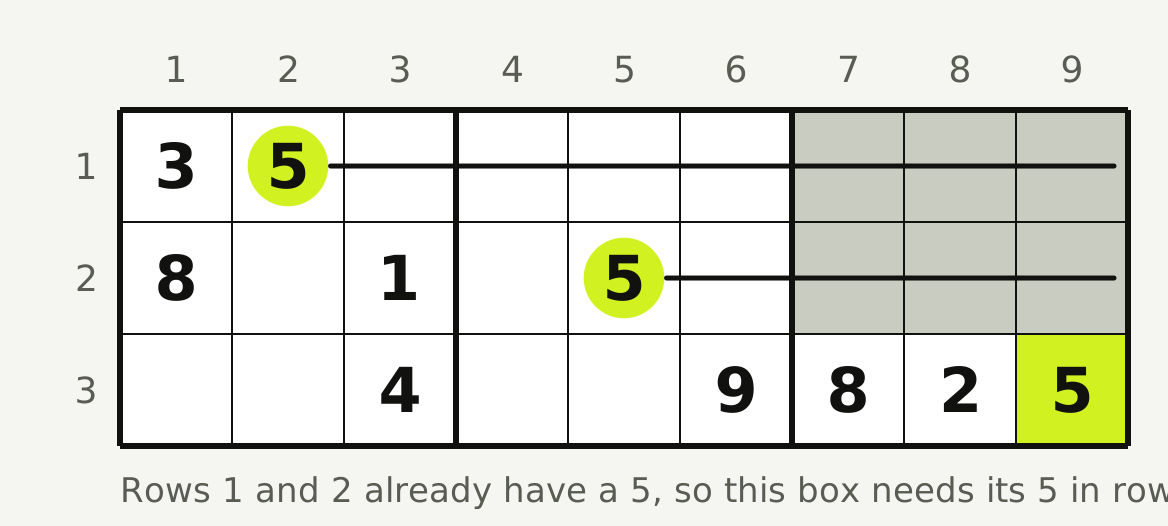
In the example, the right-hand box (columns 7 to 9) still needs a 5. Row 1 already has a 5, so the box's 5 cannot be in row 1. Row 2 already has one too. That leaves row 3, and in row 3 only column 9 is empty inside the box. So row 3, column 9 is a 5.
Scanning is fast because you do not need to write anything down. Start with the numbers that already appear most often in the grid: the more of a number is placed, the more cells it rules out. Work through 1 to 9, then go round again, because every number you place opens new scans.
Technique 2: the hidden single
What the scan above found has a name: a hidden single. A number has only one possible place left in a unit, even though that cell might, on its face, still allow other numbers [2]. It is "hidden" because if you only looked at the cell, you would not see it; you have to look at the whole unit and ask "where can the 5 go?".
Hidden singles exist in rows and columns as well as boxes. If a row is missing a 7 and every other empty cell in that row has a 7 somewhere in its column or box, the 7 goes in the remaining cell.
Technique 3: the naked single
The opposite question: instead of "where can this number go?", ask "what can this cell be?". Look at one empty cell and list every number already in its row, its column and its box. If eight different numbers are taken, the ninth is the answer. SudokuWiki calls this the last possible number: if you were tracking candidates, it would be the only one left in the cell [2].
Worked example: an empty cell's row contains 1, 3, 4 and 8; its column contains 2, 7 and 8; its box contains 5, 7 and 9. Put together, that covers 1, 2, 3, 4, 5, 7, 8 and 9. Only 6 is missing, so the cell is 6. (The 7 and 8 each appear in two lists; that does not matter, only how many different numbers are covered.)
Naked singles are slower to find by eye than hidden singles, which is why most solvers start with scanning and switch to candidates once scanning dries up.
Technique 4: pencil marks
Easy puzzles fall to scanning and singles alone. Harder ones reach a point where nothing is forced by a quick look, and you need to write down every candidate.
- For each empty cell, write in small numbers every value not already in its row, column or box.
- Look for a cell with a single candidate (a naked single) or a number that appears as a candidate only once in a unit (a hidden single).
- Every time you place a number, rub it out of the pencil marks of every cell in the same row, column and box.
Step 3 is where most mistakes come from. If you forget to clear a candidate, a later deduction is built on something false, and the error may not show until much later. Be strict about it, or use an app that clears the marks for you.
Technique 5: pairs
Pairs are the first technique that does not place a number directly. Instead, it removes candidates, which then exposes new singles.
Naked pair. If two cells in the same unit both have exactly the same two candidates, those two numbers must go in those two cells, in one order or the other. So neither number can appear anywhere else in that unit, and you can remove both from every other cell there [3].
Worked example: in row 4, the cells in columns 2 and 6 both have only 3 and 8 as candidates. One of them is 3 and the other 8, so no other cell in row 4 can be 3 or 8. If the cell in column 9 had candidates 3 and 6, remove the 3: it is now a naked single, 6. If the two paired cells are also in the same box, the 3 and 8 come out of the rest of that box too.
Hidden pair. The mirror image. If two numbers can only go in the same two cells of a unit, those cells must hold those two numbers, so every other candidate in those two cells can be removed [4].
The same reasoning works with three cells and three numbers (triples), and it is the doorway to the named patterns of harder puzzles, such as the X-wing and the swordfish.
When you are stuck
- Go back to scanning. After a few eliminations, a plain scan often finds something new.
- Check your pencil marks. A wrong or missing candidate blocks progress more often than a hard puzzle does.
- Look at box and line together. If, inside one box, a number's candidates all sit in one row, that number must be in that row within that box. You can then remove it from the rest of that row outside the box. This is often called pointing.
- Do not guess. A puzzle with one answer never needs it. If you find yourself guessing, it usually means a candidate was missed.
A little history
Sudoku came to Japan through the puzzle company Nikoli, which found it in an American puzzle magazine under the name Number Place and introduced it to its readers in 1984 [1]. The name is a short form of a longer Japanese phrase; "su" means number and "doku" means single [1]. Nikoli holds the sudoku trademark in Japan, so other Japanese publishers call the puzzle Number Place [1].
If you want to try these techniques with the bookkeeping done for you, Parlour's Sudoku clears your notes as you play and its hints name the technique they used.
Common questions
- What are the rules of sudoku?
- Fill every empty square of the 9 by 9 grid with a number from 1 to 9 so that each row, each column and each 3 by 3 box contains every number exactly once. The printed numbers stay as they are.
- Do you need to be good at maths to play sudoku?
- No. The numbers are only symbols and you never add them up. Sudoku is a logic puzzle: the same game works with letters or colours.
- What is the difference between a naked single and a hidden single?
- A naked single is a cell that can only be one number, because the other eight are already in its row, column or box. A hidden single is a number that can only go in one cell of a row, column or box, even if that cell could otherwise hold other numbers.
- Should you ever guess in sudoku?
- A properly made puzzle has one answer that logic can reach, so guessing should never be necessary. If you feel you have to guess, check your pencil marks for a missed or wrong candidate first.
- What is the fewest clues a sudoku can have?
- 17. A complete computer search in 2012 found that no puzzle with 16 clues has a single unique answer, so 17 is the minimum. Fewer clues does not always mean harder, though: difficulty depends on the techniques a puzzle needs.
- What are good sudoku tips for beginners?
- Scan one number at a time across the whole grid, starting with the numbers that appear most. When scanning stops working, write pencil marks in every empty cell, and always clear a number from its row, column and box the moment you place it.
Sources
Checked on 5 November 2026.
- 1.Nikoli, "Sudoku" (rules, name and history): https://www.nikoli.co.jp/en/puzzles/sudoku/
- 2.SudokuWiki.org, "Getting Started" (hidden singles and the last possible number): https://www.sudokuwiki.org/Getting_Started
- 3.SudokuWiki.org, "Naked Candidates": https://www.sudokuwiki.org/Naked_Candidates
- 4.SudokuWiki.org, "Hidden Candidates": https://www.sudokuwiki.org/Hidden_Candidates
- 5.McGuire, Tugemann and Civario, "There is no 16-Clue Sudoku" (arXiv, 2012): https://arxiv.org/abs/1201.0749