How to play Chinese checkers: rules, setup and strategy
Chinese checkers is a race across a six-pointed star. Each player moves ten marbles from their own point to the point opposite, one step or a chain of hops at a time, and the first to fill the far point wins.
By our team. Published . 2 sources.
Chinese checkers is a race game for two to six players on a board shaped like a six-pointed star. Each player starts with ten marbles (or pegs) filling one point of the star. On your turn you move one marble, either one step to an empty neighbouring hole or by hopping over other marbles. The first player to move all ten marbles into the point directly opposite their start wins [1]. Nothing is ever captured: marbles you hop over stay where they are [1].
Despite the name, the game is not Chinese and is not a form of checkers. It was invented in Germany in 1892 as Stern-Halma ("star Halma"), a version of the older game Halma, and the name Chinese checkers comes from a 1928 American marketing idea [1].
The board and setting up
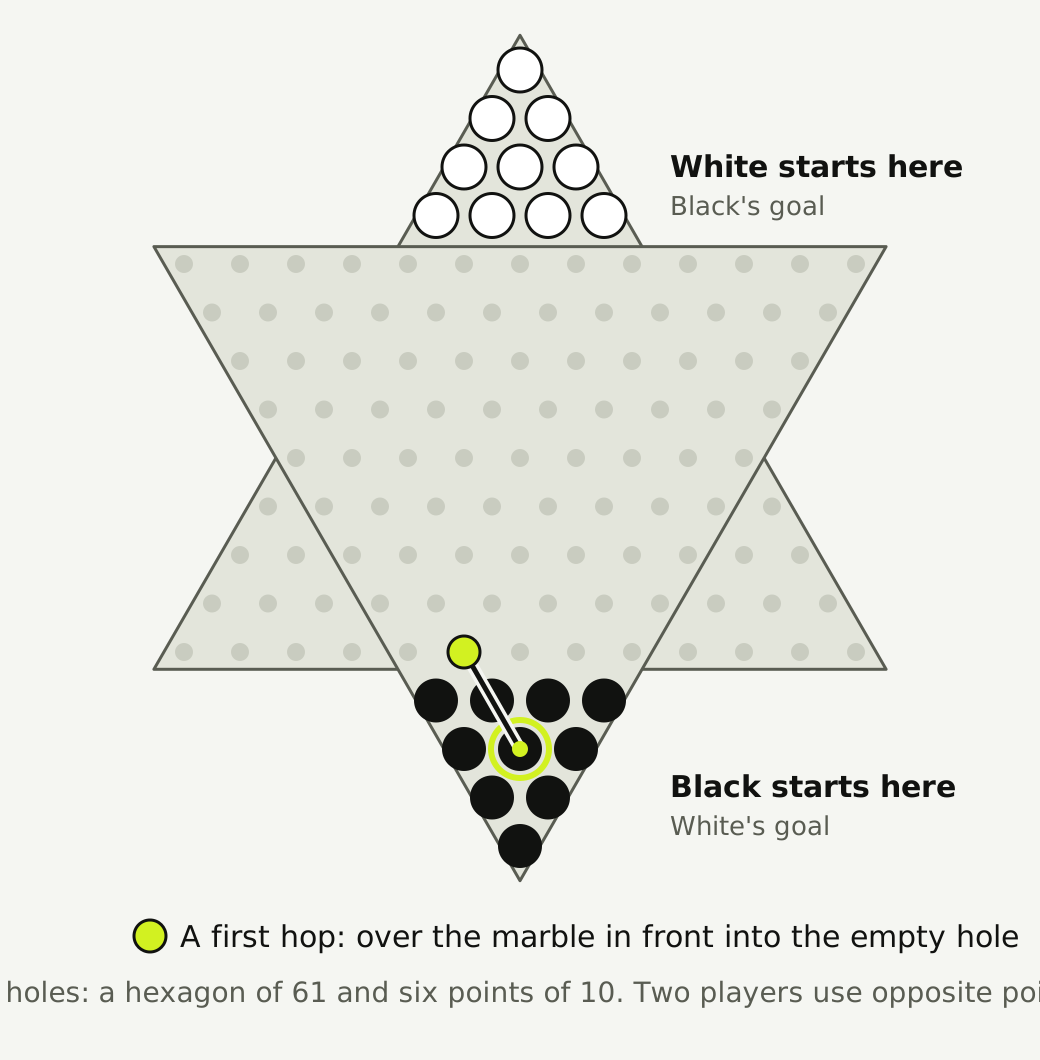
The board has 121 holes: a central hexagon of 61 holes and six triangular points of 10 holes each. Each point has its own colour and a matching set of ten marbles. Where you start depends on how many are playing [1][2]:
- Two players: opposite points, so each of you starts in the other's goal.
- Three players: three points with an empty point between each, so every player races into an empty point.
- Four players: two pairs of opposite points, leaving one opposite pair empty.
- Six players: every point is filled, and every player's goal is someone else's start.
Five players is not a standard setup, because one player's goal would be empty while the others are crowded. Some two-player games use more marbles, often 15 each in a larger triangle, but ten each is the usual game [1].
Agree who goes first (any fair method), then play passes clockwise around the board [1].
How to move
On your turn you move one of your own marbles, in one of two ways. You cannot mix them in the same turn [1].
A step
Move the marble to any empty hole next to it. Each hole has up to six neighbours, so a step can go in any of six directions, forwards, sideways or backwards [2].
A hop
Jump over one marble that sits right next to yours, in a straight line, into the empty hole directly beyond it [1][2]:
- You can hop over any marble, yours or an opponent's.
- The hole you land in must be empty, and you can only jump one marble at a time. Two marbles in a row cannot be jumped.
- The marble you jumped is not captured or removed.
Chain hops
After landing, you may hop again with the same marble, and keep going for as long as there is a marble to hop over. The chain can change direction at every hop, and you can stop wherever you like [1]. A chain is still one move, so you cannot add a step at the end of it.
Chain hops are what make the game. One well-placed marble in the middle of the board can carry another from one side to the other in a single turn, and the best players spend most of the game building these "ladders".
Where you can stop
The basic rule is simple: you can move into any empty hole, including holes in other players' points [2]. Many sets and apps add two house rules that keep the game moving:
- Passing through, not parking. A marble may hop through a point that is neither its start nor its goal, but may not end its move there. This stops players from hiding in empty corners.
- Once home, stay home. A marble that has reached its goal point may move within that point but never leaves it [2].
Agree before the game whether you are using them.
Winning, and the blocking problem
The first player to fill all ten holes of the opposite point with their own marbles wins [1]. With three or more players, the rest can carry on to decide second, third and so on [1], or you can simply stop when someone wins.
The printed rules of many sets never say what happens if an opponent leaves a marble sitting in your goal, either by parking there on purpose or by never moving it out of their own start. Left alone, that can make a win impossible. Common fixes are [2]:
- Filled counts as finished. You win once every hole of your goal is occupied, as long as the rest are yours, even if one or more holes hold an opponent's marble.
- Swap. If an opponent's marble is in the hole you need, you may swap it with your marble.
Many groups also have a rule that every player must move all their marbles out of their starting point within a set number of turns. Pick one rule before you start, especially in two-player games, where your goal is your opponent's start.
Strategy
Build ladders and use them
Move marbles so they sit one hole apart in a line towards your goal. Each gap is a place to land, so a marble at the back can hop along the whole line in one turn. Keep your marbles roughly together rather than sending one runner ahead: a lone marble has nothing to hop over and can only step.
Don't build ladders for your opponents
Every marble on the board can be hopped by anyone. Before you finish a move, look at what new chains it gives the next player. In two-player games, a move that helps both of you equally is worse than it looks, because your opponent gets to use it first.
Keep the back marbles moving
The game is won or lost on your last few marbles. A marble left in the tip of your start point is the slowest to get out, so bring the back marbles forward early, while there are still marbles in front of them to hop over.
Fill the goal from the back
When you arrive, push marbles deep into the far tip of the goal first. If you fill the front of the point first, you block your own later marbles from getting in, and every marble then has to step slowly round the edge.
Count the race
Near the end, count how many moves each player needs to get every marble home. If you are ahead, avoid complicated positions and simply walk home. If you are behind, look for a long chain hop that saves several moves at once.
Variants
- Teams. With four or six players, partners in opposite points can play as a team [1].
- More marbles. Two players can each use 15 marbles, or two sets each, for a longer game [1].
- Long hops (fast-paced Chinese checkers). Popular in France: a marble may hop over a marble that is several holes away, landing the same distance beyond it on the other side [1].
Common questions
- How many marbles do you use in Chinese checkers?
- Usually ten each, one for every hole in a point of the star. Some two-player games use 15 marbles each in a larger triangle [1].
- Can you jump your own marbles in Chinese checkers?
- Yes. You can hop over any marble, your own or an opponent's, as long as it is directly next to yours and the hole beyond it is empty [1][2].
- Do you capture marbles in Chinese checkers?
- No. Marbles you hop over stay on the board and stay in play [1].
- Can you hop and step in the same turn?
- No. A turn is either a single step or a series of hops, never a mix of the two [1].
- Can five people play Chinese checkers?
- The standard setups are for two, three, four or six players [1]. Five can play on the same board, but one player's goal is then empty while others start in occupied points, so it is less fair.
- What if an opponent's marble is blocking your goal?
- Most printed rules don't cover it. The two common fixes are to count your goal as finished once every hole is filled, even if some hold an opponent's marbles, or to let you swap your marble with the blocker [2]. Agree which before you play.
- Is Chinese checkers from China?
- No. It was invented in Germany in 1892 as Stern-Halma, and the name Chinese checkers was a 1928 American marketing choice [1].
Sources
Checked on 8 November 2026.
- 1.Wikipedia, "Chinese checkers" (history, setups, moves and variants): https://en.wikipedia.org/wiki/Chinese_checkers
- 2.Chinese checkers rules, chinesecheckers.vegard2.net (moves, stopping, blocking options): https://chinesecheckers.vegard2.net/rules_cc.html