How to play hearts: rules, passing, scoring and shooting the moon
Hearts is a four-player trick-taking game where you try not to win points. Every heart you take costs 1 point and the queen of spades costs 13. When someone reaches 100, the lowest score wins.
By our team. Published . 3 sources.
Hearts is a trick-taking card game for four players, each playing alone. Everyone gets 13 cards, passes three of them to another player, and then plays 13 tricks, following suit when they can. There are no trumps. The aim is to avoid taking penalty cards: each heart you win costs 1 point and the queen of spades costs 13. When a player reaches 100 points at the end of a hand, the player with the lowest score wins [1].
The rules below are the standard four-player game as described by pagat.com [1], which is the version most people in the US and UK know from computer versions. Where common house rules differ, we say so.
What you need
Four players, a standard 52-card pack without jokers, and paper for the score. Cards rank from ace (high) down to 2 in every suit [1].
The deal
Choose a dealer at random. The dealer shuffles and deals the whole pack one card at a time, clockwise, so each player has 13 cards [1]. The deal passes to the left after each hand. Who deals makes no difference to play, because the first lead is fixed (see below).
The pass
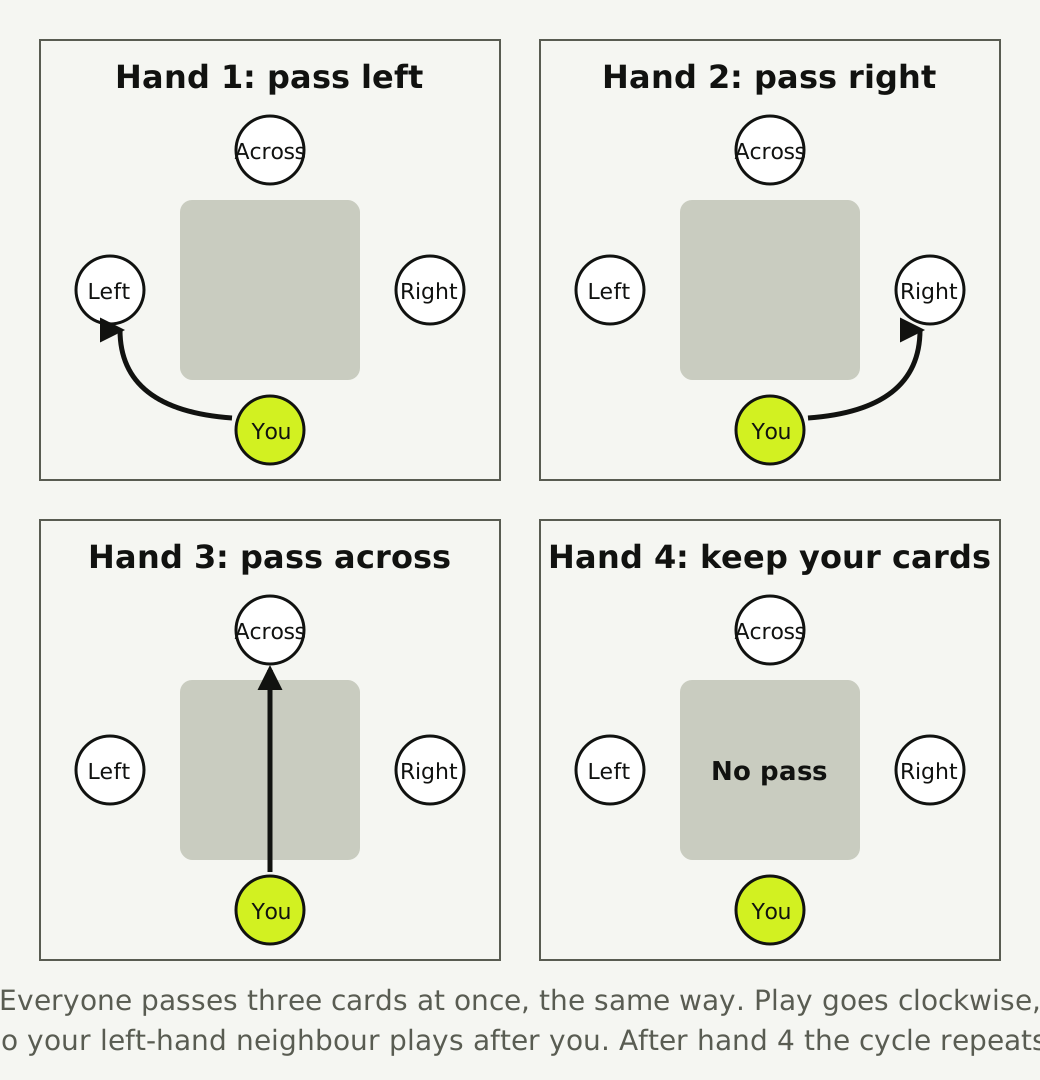
Before any card is played, each player chooses three cards from their hand and passes them face down to another player. Everyone passes at the same time, and you must choose your three cards before you look at the ones passed to you [1]. The direction changes every hand, in a cycle of four [1]:
- First hand: pass to the player on your left.
- Second hand: pass to the player on your right.
- Third hand: pass to the player across the table.
- Fourth hand: no pass. Everyone keeps their cards.
Then the cycle starts again with a pass to the left.
Playing the tricks
The player holding the two of clubs, after the pass, leads it to start the first trick [1]. Play goes clockwise. Each player must follow suit, playing a card of the suit that was led, if they can. A player with no card of that suit may play any card, which is called discarding [1]. The highest card of the suit that was led wins the trick, whatever was discarded. The winner keeps the trick face down and leads any card to the next trick, subject to the hearts rule below.
Breaking hearts
You may not lead a heart until a heart has been played to an earlier trick, which is called breaking hearts. The only exception is a player whose hand is all hearts, who may lead one at any time [1]. Hearts are normally broken by someone who cannot follow suit and discards a heart.
House rules differ on the queen of spades. In pagat.com's standard rules she does not break hearts [1]; in Bicycle's rules, discarding the queen of spades also allows hearts to be led [2]. Agree which you play before you start.
The first trick
Many players add one more rule: no penalty cards on the first trick. A player who cannot follow clubs on the opening trick may not discard a heart or the queen of spades, unless their hand has nothing else [1] [2]. This stops anyone being stuck with points before play has even begun.
Scoring
At the end of each hand, every player counts the penalty cards in the tricks they won [1]:
- Each heart: 1 point.
- The queen of spades: 13 points.
That makes 26 points in every hand. Points are bad. Write each player's total on the score sheet and keep a running score.
Shooting the moon
If one player takes all 13 hearts and the queen of spades in the same hand, they have shot the moon. Instead of taking 26 points, they score 0 and every other player takes 26 [1] [2]. Some groups let the shooter choose instead to subtract 26 from their own score [1]. Either way, shooting the moon swings the game, which is why everyone watches for it.
A few groups also play "shooting the sun", where a player who wins every trick, not just every point card, scores even more [1]. It is rare and optional.
How the game ends
The game ends at the end of a hand when at least one player has reached or passed 100 points. The player with the lowest score wins [1]. Some groups play to 50 for a shorter game [2]. If two or more players are tied for the lowest score, many play extra hands until one player is clearly lowest [1].
Common variants
- Jack of diamonds. The jack of diamonds is a bonus card: whoever takes it subtracts 10 points from their score. This version is often called Omnibus Hearts [1] [3].
- Three players. Remove the two of diamonds so each player gets 17 cards [1]. Some remove the two of clubs instead, and then the three of clubs leads [2] [3].
- Black Maria. The British cousin, usually played with three, adds penalties for the ace and king of spades as well as the queen [3].
Strategy
Choosing what to pass
The pass is the most important decision of the hand. Good cards to pass are:
- High spades when you are short of spades. The ace, king or queen of spades in a hand with only one or two other spades is dangerous, because you may be forced to win the trick the queen lands on, or play the queen yourself. With five or more spades, you can usually keep the queen safe and play under the high spades.
- High hearts. The ace and king of hearts often win tricks full of hearts late in the hand.
- Cards that let you empty a suit. If you have only two or three diamonds, passing them all leaves you void, so you can discard penalty cards when diamonds are led.
Remember which way you passed. If you passed the queen of spades to your left, that player now holds it and plays after you in every trick.
Playing low and ducking
Most of the time you want to play the highest card that will still lose the trick. That gets rid of dangerous high cards without taking points. Early in a hand, when tricks rarely hold hearts, winning a club or diamond trick is usually harmless, so it is a good moment to unload an ace or king.
Smoking out the queen
If you do not hold the queen of spades and have low spades, leading spades forces the player who has her to play her eventually. Leading spades to drive her out is a classic tactic [1]. If you hold the queen with plenty of low spades as cover, let others lead spades and keep your queen until you can discard her on a trick someone else must win.
Watching for the moon
If one player has taken every point so far and keeps leading high hearts, someone needs to take a single heart to stop them. Giving up one point is far better than taking 26. Equally, if your hand is full of high hearts and high spades, it may be worth trying to shoot the moon yourself.
Counting cards
Keep track of which suits each player has run out of and how many hearts and spades have been played. Late in a hand, knowing who can still follow suit tells you who can be made to take the last tricks.
Hearts and computer versions
Many people learnt Hearts from the version that came with Windows, which helped make this passing game, with the queen of spades as a 13-point card, the most widely played form in the US [3].
Common questions
- Who goes first in hearts?
- The player holding the two of clubs, after the pass, leads it to the first trick [1]. After that, whoever wins each trick leads the next one.
- Can you lead hearts at any time?
- No. You may not lead a heart until hearts have been broken, meaning a heart has been played to an earlier trick, unless your hand is all hearts [1]. Some house rules also count the queen of spades being played as breaking hearts [2].
- Which way do you pass in hearts?
- Three cards to the left on the first hand, to the right on the second, across on the third, and no pass on the fourth. Then the cycle repeats [1].
- How many points is the queen of spades in hearts?
- 13 points. Each heart is 1 point, so there are 26 penalty points in every hand [1].
- What does shooting the moon mean?
- Taking all 13 hearts and the queen of spades in one hand. You score 0 for the hand and every other player takes 26 points, or, under some house rules, you subtract 26 from your own score instead [1] [2].
- When does a game of hearts end?
- At the end of the hand in which someone reaches or passes 100 points. The lowest score wins [1]. Some groups play to 50 for a shorter game [2].
- Can you play hearts with three players?
- Yes. Take out the two of diamonds so the 51 remaining cards deal out to 17 each [1], or take out the two of clubs and let the three of clubs lead [2].
Sources
Checked on 8 November 2026.
- 1.pagat.com, "Hearts" (standard rules and variations): https://www.pagat.com/reverse/hearts.html
- 2.Bicycle Cards, "Hearts" rules: https://bicyclecards.com/how-to-play/hearts
- 3.Wikipedia, "Hearts (card game)" (history and variants): https://en.wikipedia.org/wiki/Hearts_(card_game)