How to play FreeCell: rules, moving runs and strategy
FreeCell is a solitaire card game in which every card is dealt face up, so almost every deal can be won with careful play. Here are the layout, every legal move, the rule for moving runs and the habits that win.
By our team. Published . 2 sources.
FreeCell is a one-player card game played with a standard 52-card pack. All the cards are dealt face up into eight columns, and you move them, one at a time, until all four suits are built from ace to king on the foundations. Four free cells give you somewhere to park single cards while you dig out the ones you need [1].
Because nothing is hidden, FreeCell is a game of planning rather than luck. Almost every deal can be won [1], so a lost game usually means a better line existed. Paul Alfille wrote the first computer version in 1978, and it reached most people through Windows, which has included it since 1995 [1].
The layout
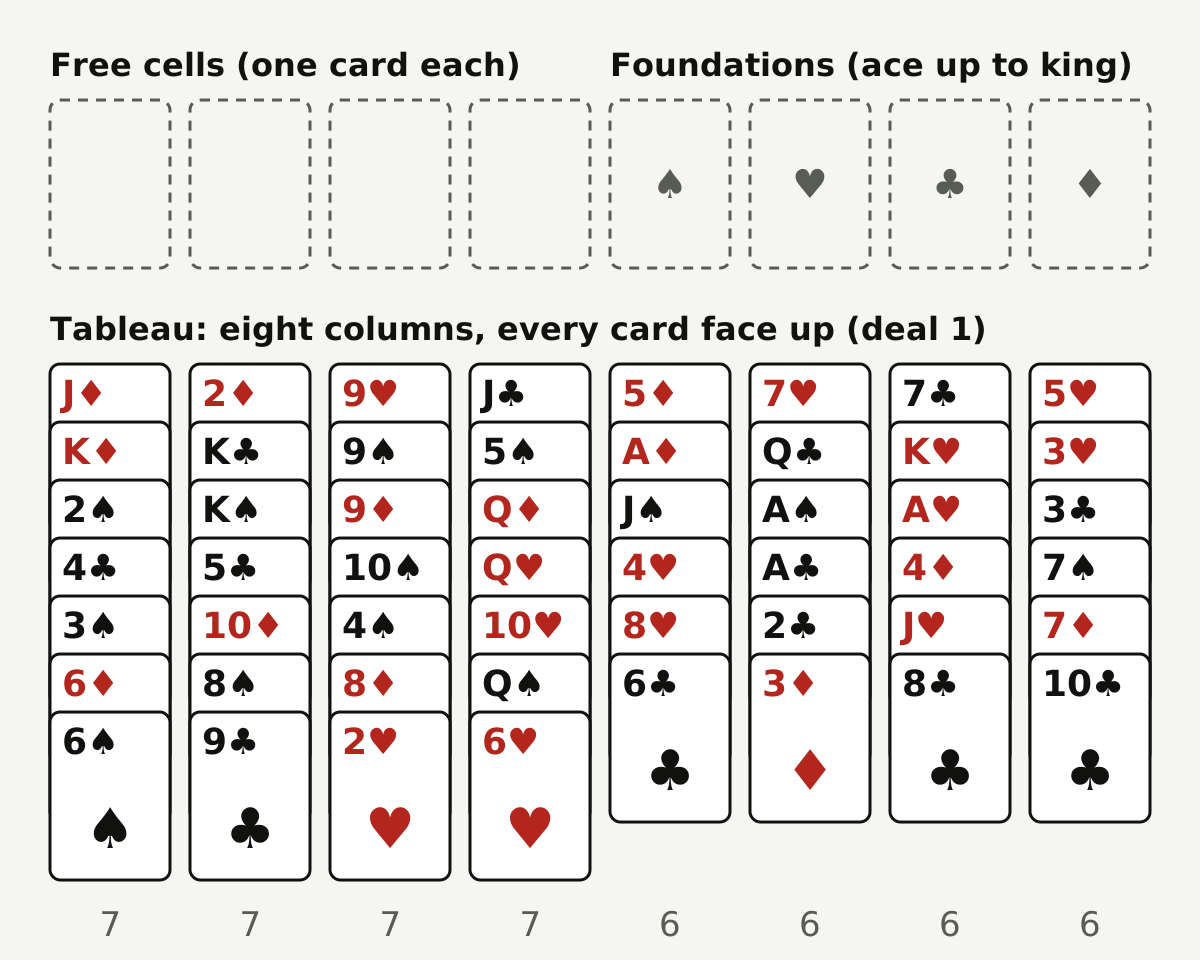
- Shuffle one 52-card pack (no jokers).
- Deal every card face up into eight columns, left to right, a row at a time. The first four columns get seven cards and the last four get six [1].
- Overlap the cards in each column so you can see them all. The card at the bottom of each column, fully visible, is the only one you can move.
- Leave space above for four free cells on the left and four foundation piles on the right [1].
Some players call the columns cascades and the foundations home cells. They mean the same things.
The rules
You may move one card at a time [1]. The cards you can move are the top card of any column (the fully visible one at the bottom of the overlap) and any card in a free cell. Each card can go to one of four places:
- A foundation. Each foundation holds one suit, built up in order from ace to king. An ace starts a foundation, then the two of the same suit, and so on [1].
- Another column. A card can go on a card one rank higher and of the opposite colour: a red nine on a black ten, a black four on a red five. Columns are built down in alternating colours, regardless of suit [1].
- An empty free cell. Each free cell holds exactly one card, of any kind [1].
- An empty column. When a column is cleared, any card can be put there, not only a king [1].
Cards on the foundations stay there in most versions of the game. You win when all 52 cards are on the foundations [1].
Moving several cards at once
The rules say one card at a time, but you can move a run (a sequence in alternating colours, each card one lower than the one before) by shuttling cards through empty free cells and empty columns. Almost every computer version does those steps for you and lets you move the whole run in one go, often called a supermove [1] [2]. The longest run you can move is fixed by how much empty space you have [1]:
- Onto another column: (empty free cells + 1) x 2 to the power of the number of empty columns.
- Into an empty column: half that, because the column you are moving into no longer counts as spare space.
Some worked examples:
| Empty free cells | Empty columns | Most cards onto a column |
|---|---|---|
| 0 | 0 | 1 |
| 4 | 0 | 5 |
| 2 | 1 | 6 |
| 1 | 2 | 8 |
| 4 | 1 | 10 |
This is why an empty column is so valuable: each one doubles what you can move, while each free cell only adds one.
Can every deal be won?
The classic Windows game numbered its deals from 1 to 32,000, and players worked out that only one of them, deal 11982, cannot be won [1]. Across all possible shuffles the picture is similar: computer searches have found that roughly one deal in 84,000 is unwinnable, so about 99.999% can be won with four free cells [1].
That does not make every deal easy. Some need long, careful sequences. With fewer free cells the game gets much harder, and the original PLATO version already let players change the number of cells and columns [1] [2].
Strategy
Look before you move
Every card is visible, so scan the whole layout first. Find the aces and twos, note what is sitting on top of them, and plan how to reach them. A few seconds of planning at the start saves many moves later.
Free the aces and low cards early
Low cards buried near the top of a column (the back of the overlap) block everything. Work towards the aces and twos first, and get them onto the foundations as soon as they are free.
Treat free cells as scarce
Free cells are the easiest place to put a card and the easiest way to lose a game. Every card in a cell cuts how many cards you can move at once. Use a cell when it achieves something specific, such as uncovering an ace, and empty it again as soon as you can.
Empty a column, then keep it
An empty column is worth more than all four free cells together, because it doubles the size of run you can move. Clearing a short column early is often the best plan in a deal. Do not fill an empty column with a single low card unless you have to; a king with a long run under it is a better use, because it will never need to move again.
Do not rush cards home
Moving a card to its foundation is usually right, but not always. A black five on the foundation can no longer hold a red four in the columns. If you still need the five as a stepping stone, leave it out for now. Cards that no column could ever need again, such as a three of hearts when both black twos are home, are safe to send up.
Build long runs on high cards
Runs that start on a king or queen can stay put while you work elsewhere. Runs built on low cards will have to move again, which costs space.
FreeCell and Baker's Game
FreeCell grew out of an older game. Baker's Game, described by Martin Gardner in 1968, has the same layout and cells, but columns are built down by suit rather than by alternating colour, which makes it much harder [1]. FreeCell's alternating colours give you twice as many places to put each card.
Common questions
- How many cards can you move at once in FreeCell?
- Strictly one, but you can move a run if there is room to shuttle it: (empty free cells + 1) x 2 to the power of the number of empty columns, or half that when the destination is an empty column [1].
- Can you put any card in an empty column in FreeCell?
- Yes. Unlike Klondike, where only a king can fill an empty column, FreeCell lets any card or run go into an empty column [1].
- Is every FreeCell game winnable?
- Almost. Of the classic 32,000 numbered deals only deal 11982 cannot be won, and across all shuffles about one deal in 84,000 is unwinnable [1].
- What is the hardest FreeCell deal?
- Deal 11982 is the famous one because it cannot be won at all [1]. Among winnable deals, difficulty depends on how deep the aces and twos are buried and how many long runs are already in place.
- Can you take cards back off the foundations?
- Not in standard FreeCell. Once a card is on its foundation it stays there, so think twice before sending up a card you might still need in the columns.
- What is the difference between FreeCell and solitaire?
- Klondike solitaire deals most cards face down and adds a stock to draw from, so luck decides many games. FreeCell deals every card face up into eight columns and has four free cells instead of a stock, so almost every deal can be won with planning [1].
Sources
Checked on 8 November 2026.
- 1.Wikipedia, "FreeCell" (history, layout, rules, moving runs, deal 11982 and solvability): https://en.wikipedia.org/wiki/FreeCell
- 2.FreeCell.net, "Instructions" (open columns, multi-card moves and layouts with fewer cells): https://freecell.net/f/c/instructions.html