How to play reversi: rules, starting position and strategy
Reversi is a two-player game of 64 two-coloured discs on an 8x8 board. You place a disc so it traps a line of your opponent's discs, they flip to your colour, and whoever has more discs at the end wins.
By our team. Published . 1 source.
Reversi is played on an 8x8 board with 64 discs that are black on one side and white on the other. Black moves first. On your turn you place one disc of your colour so that it traps one or more straight lines of your opponent's discs between it and another of your discs, and every trapped disc flips to your colour. If you cannot trap anything, you pass. When neither player can move, the player with more discs showing wins [1].
The game dates from the 1880s in England [1]. The rules below are the standard modern ones, with a fixed starting position, used by the modern commercial version of the game, by world championship play and by most apps.
The starting position
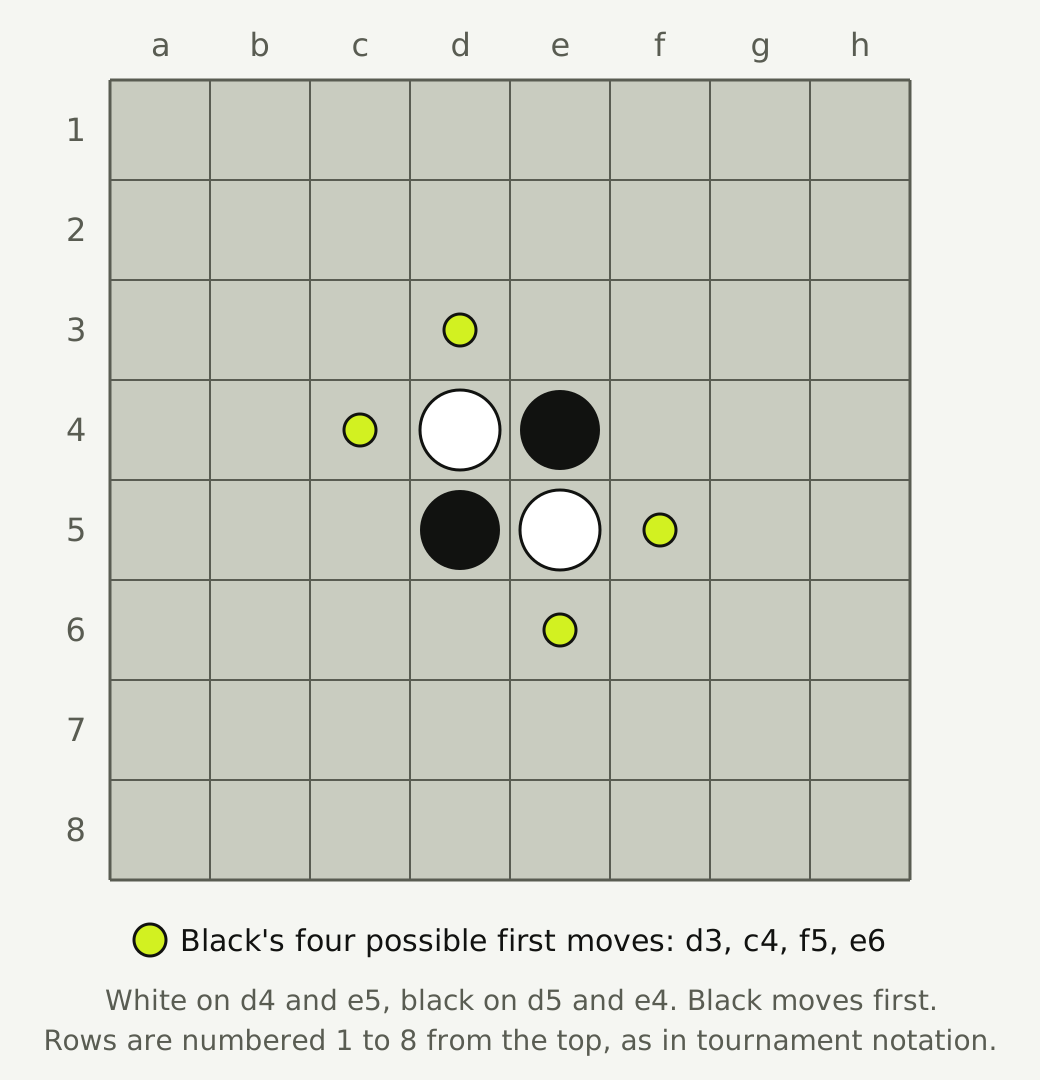
- Place the board between you. Columns are lettered a to h from left to right, and in tournament notation rows are numbered 1 to 8 from top to bottom.
- Put four discs in the four centre squares, with matching colours on the diagonals: white on d4 and e5, black on d5 and e4 [1].
- Share out the remaining discs. If one player runs out before the end, the other hands over a disc so play can continue.
- Black moves first [1].
Some older rule sets start with an empty board and have each player place their first two discs in the four centre squares without flipping anything [1]. If you play that way, agree it before you start.
How a move works
On your turn you place one disc, your colour face up, on an empty square. The move is legal only if it outflanks at least one of your opponent's discs [1]:
- Outflanking means there is a straight, unbroken line of one or more opposing discs running from the square you play on to another disc of your colour.
- The line can run in any of eight directions: up, down, left, right, or along either diagonal in either direction.
- There can be no empty squares and none of your own discs in the middle of the line.
Every opposing disc in every outflanked line flips to your colour, in all directions at once. You cannot choose to flip only some of them.
Two details catch new players:
- Flips do not chain. Only the lines that run from the disc you just placed are flipped. A disc that changes colour does not then flip further discs on its own.
- You must flip at least one disc. A disc placed next to an opposing disc that does not trap a line is not a legal move.
From the starting position, black has exactly four legal moves, d3, c4, f5 and e6, marked in the diagram. Each one flips a single white disc, and all four are equally good because the position is symmetrical [1]. For example, black on f5 traps the white disc on e5 against the black disc on d5, so e5 turns black.
Passing
If you have no legal move, you pass and your opponent moves again [1]. You may not pass when a legal move exists, even if every legal move is bad for you. A player can pass several turns in a row while the other keeps playing.
How the game ends and scoring
The game ends when neither player can make a legal move [1]. That usually happens when the board is full, but it can happen earlier, for example when one colour has been wiped out or when both players are stuck with empty squares left.
Count the discs of each colour; the player with more wins, and equal counts are a draw [1]. In tournament play, any empty squares left at the end are added to the winner's total, so a game can end 40 to 20 with 4 squares empty and be recorded as 44 to 20. Casual games usually just compare the counts.
Strategy: why grabbing discs loses
The score only counts at the end, and discs can change colour many times before then. The most common beginner mistake is to flip as many discs as possible on every move. Strong players do the opposite in the opening and middle game.
Corners
A disc in a corner can never be flipped, because no line can run through it. Corners also make the edge discs next to them stable, so a corner often wins a whole edge later. Take corners when you can, and work to make your opponent give them to you.
The squares next to corners
The square diagonally inside each corner (b2, g2, b7 and g7, often called X-squares) is the most dangerous square on the board while that corner is empty. Play there and your opponent can often take the corner along the diagonal. The edge squares beside a corner (C-squares, such as b1 and a2) carry a similar risk. Avoid both until the corner is settled.
Mobility
The player with more legal moves tends to win, because the player with few moves is eventually forced into bad squares like X-squares. Aim to:
- Flip few discs in the opening, preferably discs in the middle of the board.
- Keep your discs in a compact group rather than spread around the outside.
- Make moves that leave your opponent with as few legal replies as possible.
Frontier discs
A frontier disc is one next to an empty square. Every frontier disc of yours is something your opponent can play against, so moves that create many new frontier discs give your opponent options. "Quiet" moves that flip interior discs and add little to the frontier are usually best.
Edges
Edges are safer than the middle because they can only be flipped along the edge, but an edge disc that your opponent can outflank may hand them the corner. Before playing on an edge, check what happens if your opponent answers on the same edge.
The endgame
Near the end, count. With few empty squares left, it often pays to get the last move in each region of empty squares (parity), and to calculate exactly which disc flips where.
Reversi and the modern commercial version
The commercial game sold since the 1970s is reversi with fixed rules: the diagonal starting position above, black moving first, and passing when you cannot move [1]. Rules sometimes found in older reversi sets, such as an empty starting board or a fixed supply of discs that ends the game when one player runs out, are variations. Most apps and online sites called reversi use the modern rules on this page.
Common questions
- Who goes first in reversi?
- Black (the dark colour) moves first under the standard modern rules [1].
- What happens if you cannot move in reversi?
- You pass and your opponent moves again. You may only pass when you have no legal move. If neither player can move, the game ends [1].
- Do you flip discs in every direction?
- Yes. A placed disc flips every opposing line it outflanks, horizontally, vertically and diagonally, all at once. Discs flipped by the move do not go on to flip others.
- Does the game end when the board is full?
- It ends when neither player can make a legal move [1]. That is usually when the board is full, but it can come earlier if both players are stuck or one colour has no discs left.
- Is reversi the same as the game with the green board?
- The modern commercial version uses the same rules as standard reversi on this page: the diagonal starting position and black moving first [1]. Older reversi sets sometimes start with an empty board.
- What is the best first move in reversi?
- There isn't one. Black's four legal first moves (d3, c4, f5 and e6) are mirror images of each other, so they are equally good [1].
Sources
Checked on 5 November 2026.
- 1.Wikipedia, "Reversi" (history, rules and starting position): https://en.wikipedia.org/wiki/Reversi