How to play Ludo: rules, board and house rules
Each player races four tokens clockwise round the board and up their own home column. Roll a six to bring a token out, land on opponents to send them back, and get all four home first to win.
By our team. Published . 1 source.
Ludo is a race game for two to four players. Each player has four tokens in a corner base. You need to roll a six to bring a token out onto your start square. Then you move tokens clockwise round the shared track and up your own coloured home column. Land exactly on an opponent's token and it goes back to its base. The first player to get all four tokens into the centre wins.
That is the whole game. The rest of this page covers the board, a full turn, and the rules people argue about: safe squares, blocks, extra rolls and three sixes. Agree on those before the first roll.
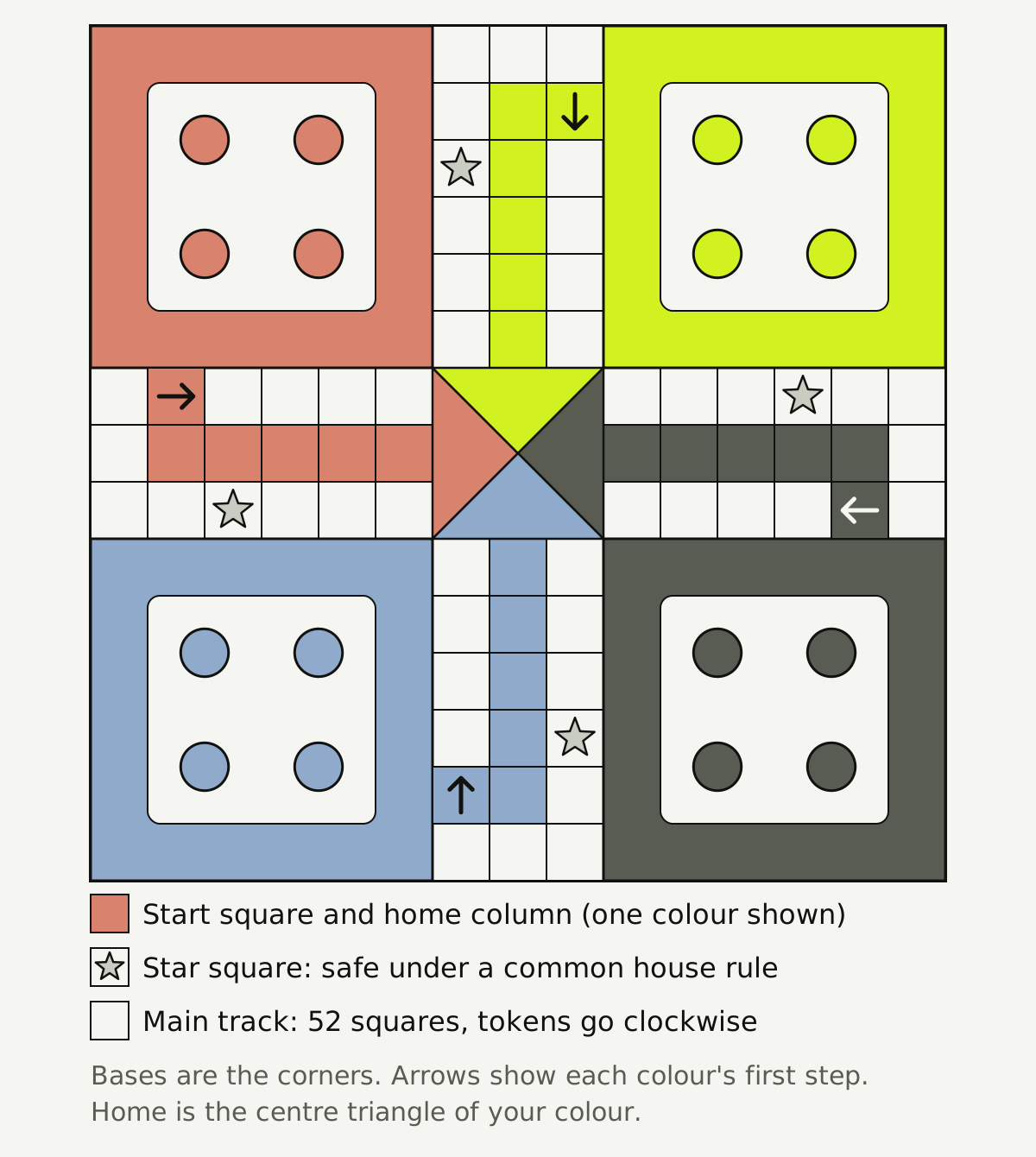
What you need
- A Ludo board: a square board with a cross-shaped track. Each arm of the cross is three columns of six squares [1].
- Four tokens per player, in four colours.
- One six-sided die (some sets add a cup).
In the UK most people know the game as Ludo. It is the English version of Pachisi, the cross-and-circle race game from India, and was sold in England from the 1890s [1]. Germany's Mensch ärgere Dich nicht, from 1914, is a close relative [1]. In the US, the same family of games is mostly sold under trademarked brand names, so if you grew up with one of those you already know most of this.
The board
- Bases (yards): the four big corner squares, one per colour. Tokens start here.
- Start square: the coloured square just outside your base, on the track. A token that leaves base goes here.
- The track: the 52 squares running round the outside of the cross, start squares included. Every player shares it.
- Home column: the five coloured squares up the middle of your arm. Only your tokens can enter it, so tokens there are always safe [1].
- Home: the triangle of your colour in the centre.
Setting up
- Each player picks a colour and puts their four tokens in that base.
- With two players, sit at opposite corners so both have the same distance to travel before meeting.
- Everyone rolls the die once. The highest roll goes first, and play passes clockwise (to the left).
How a turn works
- Roll the die.
- Move one token that many squares, clockwise along the track. You choose which token. If none of your tokens can move, the turn passes.
- Leaving base needs a six. With a six, you can bring a new token out onto your start square, or move a token that is already out.
- A six earns another roll. Take your move, then roll again.
- Three sixes in a row usually end your turn without the third move. This is a widespread rule but not in every rule sheet, so agree on it first.
At the end of a lap, your token passes the square just before your start square and turns up your home column instead of going round again.
Capturing
If your token ends its move on a square holding an opponent's token, the opponent's token is captured and goes back to its base [1]. To come back out it needs another six. You only capture by landing exactly on the square. Passing over a token does nothing.
Your own home column cannot be entered by anyone else, so a token there can never be captured.
Safe squares: traditional and house rules
This is where sets and families differ most.
| Rule | Where it comes from |
|---|---|
| Home column squares are safe | Every version: opponents cannot enter them [1] |
| Start squares are safe | Common house rule, and printed on many modern boards |
| Star (or globe) squares are safe | House rule from modern sets and apps; a Danish variant uses globe and star squares [1] |
| No safe squares on the track at all | The basic rules as usually written, where only the home column is safe [1] |
On boards with stars, they usually sit on the eighth square after each start square, as in the diagram above. A token on a safe square cannot be captured. In most house rules, tokens of different colours can then share it.
Blocks
Two tokens of the same colour on one square form a block. Rules vary on what that does:
- Common house rule: opponents cannot land on or pass a block. They have to move another token or wait.
- Another rule given in some sources: an opponent who lands on a block is sent back to base [1].
- Simplest: blocks have no effect, and a token landing there captures both.
Pick one before you start. Blocks make the game slower and more tactical.
Getting home
You need the exact number to move a token into the centre [1]. If your roll is too high for a token in the home column, move a different token instead. If no token can use the roll, your turn passes. Some families let an overshooting token bounce back down the column. It is a house rule, not the usual one.
Extra rolls and other common house rules
- Extra roll for a capture: many players give a bonus roll for capturing a token. Others give one when a token reaches home.
- Any roll leaves base: some play that a one also brings a token out, or that a token can leave on any roll. This speeds the game up for young children.
- Two dice: some regional versions use two dice. In one Indian form, a one also lets a token enter [1].
None of these are wrong. Just decide which ones are in before you start.
Winning
The first player with all four tokens home wins. If you want places for everyone, keep playing until only one player is left on the track.
Team play
With four players you can play in pairs, with partners sitting in opposite corners. Ludo is normally played every player for themselves. Partnerships are a variant: Danish rules include one [1]. A common way to play it is that a team wins when both partners have all eight tokens home. Decide in advance whether you can capture your partner's tokens and whether you can share blocks with them.
Tips for winning more often
- Get two tokens out early. One token on the track gives you no choice when it is in danger.
- Count the danger zone. An opponent token one to six squares behind you can hit you on its next roll. Sitting seven or more squares ahead of it is safer.
- Use safe squares as stepping stones if your table plays with them.
- Do not race one token home while the others sit in base. A lone runner in the home column has to wait for exact rolls.
- Capture when it costs the opponent the most. Hitting a token that has nearly finished a lap does far more damage than hitting one that just came out.
You can try different house rules against the computer in our app Parlour before teaching them at the table.
Common questions
- Do you need a six to start in Ludo?
- In the standard rules, yes: a token leaves base only on a six, and a captured token needs another six to come back out [1]. Some families let a one or any roll bring a token out to speed the game up.
- What happens if you roll three sixes in a row?
- Under the most common rule, the third six ends your turn and you do not move for it [1]. Not every rule sheet includes this, so agree on it before you play.
- Which squares are safe in Ludo?
- Your home column is always safe because no one else can enter it. Many modern boards also mark the start squares and star squares as safe, but that is a house rule rather than part of the basic English rules.
- Can you capture a token on its start square?
- Only if your table does not treat start squares as safe. Many families do treat them as safe, which also stops a player being captured the moment a token comes out.
- Do you get an extra turn for capturing in Ludo?
- Only under a house rule. The basic rule gives an extra roll for a six. Many players also give one for a capture or for getting a token home.
- Can two players play Ludo?
- Yes. Ludo works for two, three or four players [1]. With two, sit at opposite corners. Each player can also run two colours if you want a longer game.
- Do you need an exact roll to get home?
- Yes. A token needs the exact number to reach the centre [1]. If the roll is too high, move another token, or pass if none can move.
Sources
Checked on 5 November 2026.
- 1.Ludo (board game), Wikipedia: https://en.wikipedia.org/wiki/Ludo