How to play chess: rules, setup and how the pieces move
Each player has 16 pieces and the aim is to checkmate the other king. This page covers the setup, every piece's move in one table, the three special moves and every way a game is drawn, following the FIDE Laws.
By our team. Published . 2 sources.
Chess is a game for two players on a board of 64 squares. Each side starts with 16 pieces: a king, a queen, two rooks, two bishops, two knights and eight pawns. White moves first, the players take turns moving one piece, and you win by checkmating the other king: attacking it so that it has no way to escape [1].
Everything below follows the Laws of Chess published by FIDE, the international chess federation, which is the rulebook used in clubs and tournaments worldwide [1].
Setting up the board
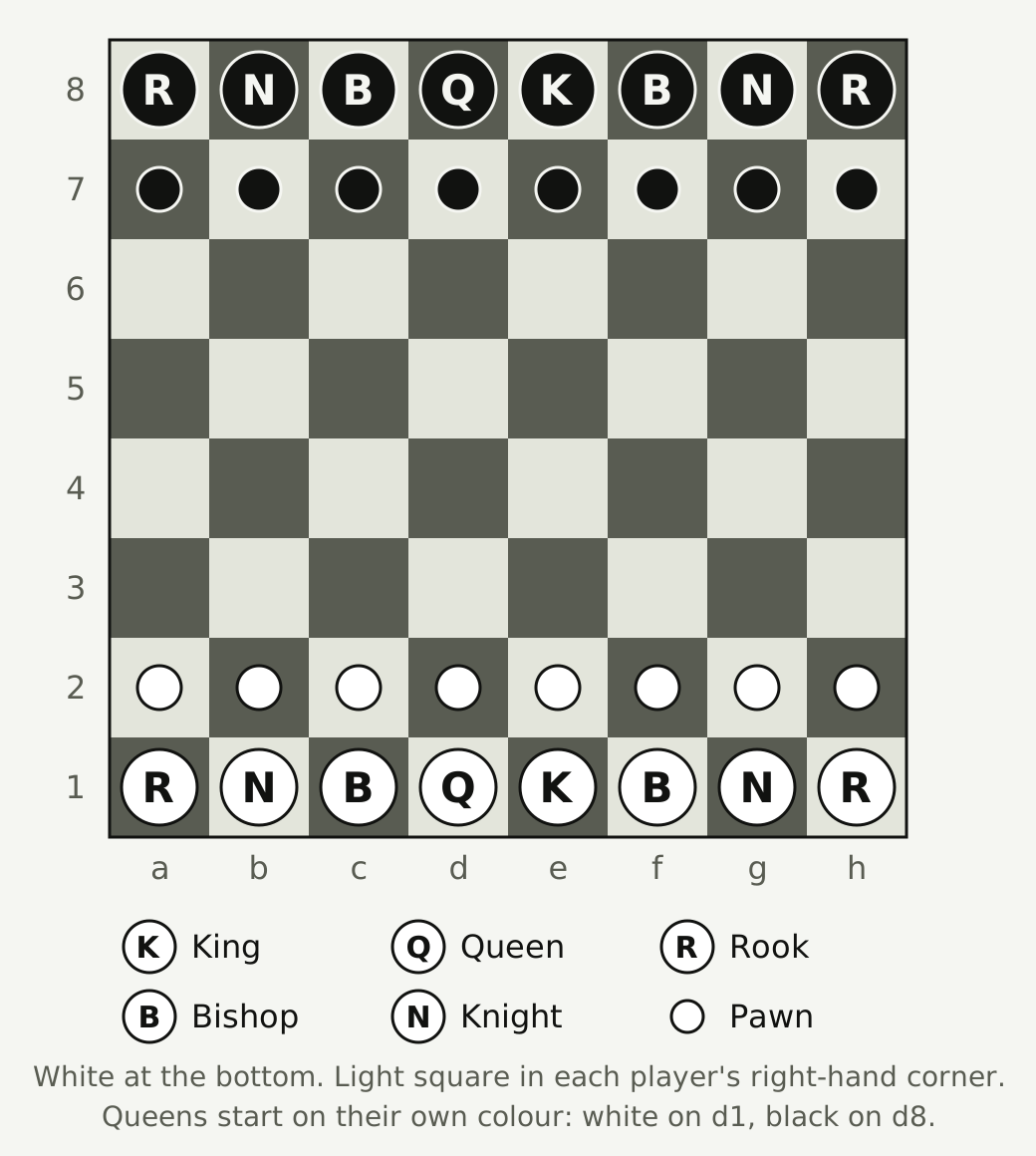
- Put the board between you so that each player has a light square in the near right-hand corner. "Light on the right" is the rule [1].
- The columns are called files and are lettered a to h from White's left. The rows are called ranks and are numbered 1 to 8 from White's side. Every square has a name, such as e4.
- White's back rank, from a1 to h1: rook, knight, bishop, queen, king, bishop, knight, rook. Black mirrors it on rank 8.
- The queen goes on her own colour: the white queen on the light square d1, the black queen on the dark square d8. The kings face each other on the e-file.
- Fill the second rank in front of each army with eight pawns (rank 2 for White, rank 7 for Black).
If your kings and queens are the wrong way round, the queens are not on their own colour, so swap them.
How the pieces move
A piece moves to an empty square or captures by moving onto a square occupied by an opposing piece, which is removed from the board. No piece except the knight can jump over other pieces, and you can never capture your own pieces [1].
| Piece | How it moves | Notes |
|---|---|---|
| King | One square in any direction | May never move onto a square attacked by an enemy piece. Also castles (below). |
| Queen | Any number of squares in a straight line: along a rank, a file or a diagonal | The most powerful piece: a rook and bishop combined. |
| Rook | Any number of squares along a rank or a file | Also takes part in castling. |
| Bishop | Any number of squares along a diagonal | Stays on the colour it starts on for the whole game. |
| Knight | In an L: two squares in a straight line, then one square to the side | The only piece that jumps over others. It always lands on a square of the opposite colour. |
| Pawn | One square straight forward; two squares forward on its first move if both squares are empty | Captures one square diagonally forward, never straight ahead. Never moves backwards. Has two special moves: en passant and promotion. |
A pawn is the only piece that captures differently from how it moves. A pawn blocked by any piece directly in front of it cannot move forward, even though it may still capture diagonally.
Check, checkmate and stalemate
Check. When your king is attacked by an enemy piece, it is in check. You must get out of check on your move, in one of three ways: move the king to a safe square, capture the attacking piece, or put a piece in between (not possible against a knight or a pawn). You may never make a move that leaves or puts your own king in check, which is why a piece shielding its king from attack (a pinned piece) is sometimes unable to move [1].
Checkmate. If your king is in check and no legal move gets it out, it is checkmate and you lose. The king is never actually captured: the game ends at checkmate [1].
Stalemate. If it is your turn, your king is not in check, but you have no legal move at all, the game is a draw by stalemate [1]. It is the classic way for the side that is winning to throw away the win, so when you are well ahead, always leave the opposing king a square to move to until you can deliver mate.
The three special moves
Castling
Castling is a single move of the king and a rook together, and the only time you move two pieces in one turn. The king moves two squares towards a rook, and that rook jumps over to the square the king crossed [1]. Castling short (on the king's side) puts the white king on g1 and rook on f1; castling long (on the queen's side) puts the king on c1 and rook on d1. Black castles the same way on rank 8.
You can castle only if all of these are true [1]:
- Neither the king nor that rook has moved yet in the game.
- There are no pieces between them.
- Your king is not in check.
- The king does not pass over or land on a square that an enemy piece attacks. The rook may pass over an attacked square, which matters when castling long.
Move the king first. In a tournament, touching the rook first counts as starting a rook move [1].
En passant
If a pawn moves two squares forward from its starting square and lands right beside one of your pawns, your pawn may capture it as if it had moved only one square: move your pawn diagonally onto the square the enemy pawn passed over and remove the enemy pawn. You can do this only on the very next move; wait a turn and the chance has gone [1]. "En passant" is French for "in passing".
Promotion
When a pawn reaches the far rank (rank 8 for White, rank 1 for Black), it must be exchanged in the same move for a queen, rook, bishop or knight of the same colour. You choose, and it does not matter which pieces have been captured, so you can have two or more queens [1]. Almost everyone chooses a queen; a knight is the usual exception, when its fork or check wins on the spot.
How a game ends
Win. You win by checkmate, when your opponent resigns, or in a timed game when your opponent runs out of time and you still have a way to checkmate [1].
Draw. A game is drawn in any of these cases [1]:
| Draw | What happens |
|---|---|
| Stalemate | The player to move has no legal move and is not in check. |
| Dead position | Neither side can checkmate by any series of legal moves, for example king against king, or king and bishop against king. |
| Agreement | One player offers a draw and the other accepts. |
| Threefold repetition | The same position, with the same player to move and the same possible moves, occurs for the third time. The player to move can claim the draw. |
| Fifty-move rule | Fifty moves by each player in a row without a pawn move or a capture. Either player can claim the draw. |
| Fivefold repetition and seventy-five-move rule | The same position five times, or seventy-five moves each without a pawn move or capture: the game is drawn automatically, with no claim needed. |
Under FIDE rules, threefold repetition and the fifty-move rule are claims: if nobody claims, play continues. Many chess apps, Parlour among them, end the game automatically at that point instead.
Rules for playing over the board
- Touch-move. In a tournament, if you deliberately touch one of your pieces, you must move it if it has a legal move; if you touch an opponent's piece, you must capture it if you can. Say "I adjust" before straightening a piece [1].
- Illegal moves. In casual games, an illegal move is simply taken back and replaced. In rated play there are penalties [1].
- Clocks. With a chess clock, you press your clock with the same hand you moved with, and a player who runs out of time loses unless the opponent cannot possibly checkmate [1].
Strategy for your first games
You do not need openings to start playing well. These habits win most beginner games:
- Look before every move. Ask what your opponent's last move attacks, then check every capture and check available to both sides. Many beginner games are decided by a piece left undefended.
- Fight for the centre. Start with a centre pawn (e4 or d4 for White) so that your bishops and queen can get out.
- Develop your knights and bishops early. Bring them off the back rank before moving any piece twice. Knights usually belong on c3 and f3 (c6 and f6 for Black).
- Castle early. Castling in the first ten moves or so tucks your king away and brings a rook towards the centre.
- Keep your queen back at first. Brought out early, it gets chased by minor pieces while your opponent develops with tempo.
- Count before you trade. The usual guide is pawn 1, knight 3, bishop 3, rook 5, queen 9 [2]. A trade that gives up more points than it takes is usually a mistake, unless it leads to checkmate.
- Watch out for the four-move mate. White plays e4, Bc4 and Qh5 (or Qf3), then takes on f7 with mate. As Black, defend f7: a knight on f6 blocks the queen's path, and moving the e-pawn early gives your bishop and queen room.
Writing down moves
Chess games are recorded in algebraic notation: the piece letter (K, Q, R, B, N; no letter for a pawn) followed by the square it moves to, so Nf3 means a knight moves to f3. An x marks a capture (Bxe5), + marks check, # marks checkmate, O-O is castling short and O-O-O castling long [1]. Learning it lets you follow books, videos and the move lists in apps.
Common questions
- Who moves first in chess?
- White always moves first. In a series of games, players usually swap colours each game.
- Can a pawn move backwards?
- No. Pawns only ever move forward, one square at a time (two on their first move), and capture one square diagonally forward. When a pawn reaches the far side it is promoted to another piece.
- Can you castle out of check or through check?
- No to both. You cannot castle while your king is in check, and the king may not pass over or land on a square an enemy piece attacks. The rook, however, may pass over an attacked square [1].
- Is stalemate a win or a draw?
- A draw. If the player to move is not in check but has no legal move, the game ends immediately as a draw by stalemate [1].
- What is en passant?
- When a pawn moves two squares from its starting square and lands beside an enemy pawn, the enemy pawn may capture it as if it had moved one square. It must be done on the very next move or not at all [1].
- Can you have two queens?
- Yes. A pawn that reaches the last rank can be promoted to a queen whatever pieces are still on the board, so a player can have several queens at once [1].
- How many moves does it take to checkmate?
- The fastest possible checkmate takes two moves by Black (the fool's mate: 1. f3 e5 2. g4 Qh4#). The four-move mate with queen and bishop against f7 catches many beginners, so learn to defend that square first.
Sources
Checked on 5 November 2026.
- 1.FIDE Handbook, "Laws of Chess" (applied from 1 January 2023): https://handbook.fide.com/chapter/E012023
- 2.Wikipedia, "Chess piece relative value": https://en.wikipedia.org/wiki/Chess_piece_relative_value