How to play eight-ball pool: rules, the rack, fouls and how to win
Eight-ball is pool's most played game: one player takes the solids (1 to 7), the other the stripes (9 to 15). Clear your group, then pot the black 8 in the pocket you call to win.
By our team. Published . 4 sources.
Eight-ball is played with a cue ball and fifteen numbered object balls: the solids, 1 to 7, the stripes, 9 to 15, and the black 8. After the break, the first player to pot a ball legally takes that group, and the other player gets the other group. You keep shooting while you pot balls from your group. Once your group is cleared, you shoot at the 8, and potting it in the pocket you called wins the game. Pot the 8 early, on a foul or in the wrong pocket, and you lose [1].
The rules below are the World Pool-Billiard Association's (WPA) rules for 8-ball, the international standard [1], with notes on the shortcuts most casual players take. If you play in a British pub with red and yellow balls, the game is usually blackball, which is close but not the same; the differences are covered further down.
The equipment
- Balls: the white cue ball, seven solids (1 to 7), seven stripes (9 to 15) and the 8 [1].
- Table: six pockets [2], with a head end (where you break from) and a foot end (where the balls are racked). The head string is an imaginary line across the table a quarter of the way from the head cushion, and the foot spot sits on the centre line at the matching point a quarter of the way from the foot cushion [3].
- A triangle to rack the balls, and a cue each.
Racking
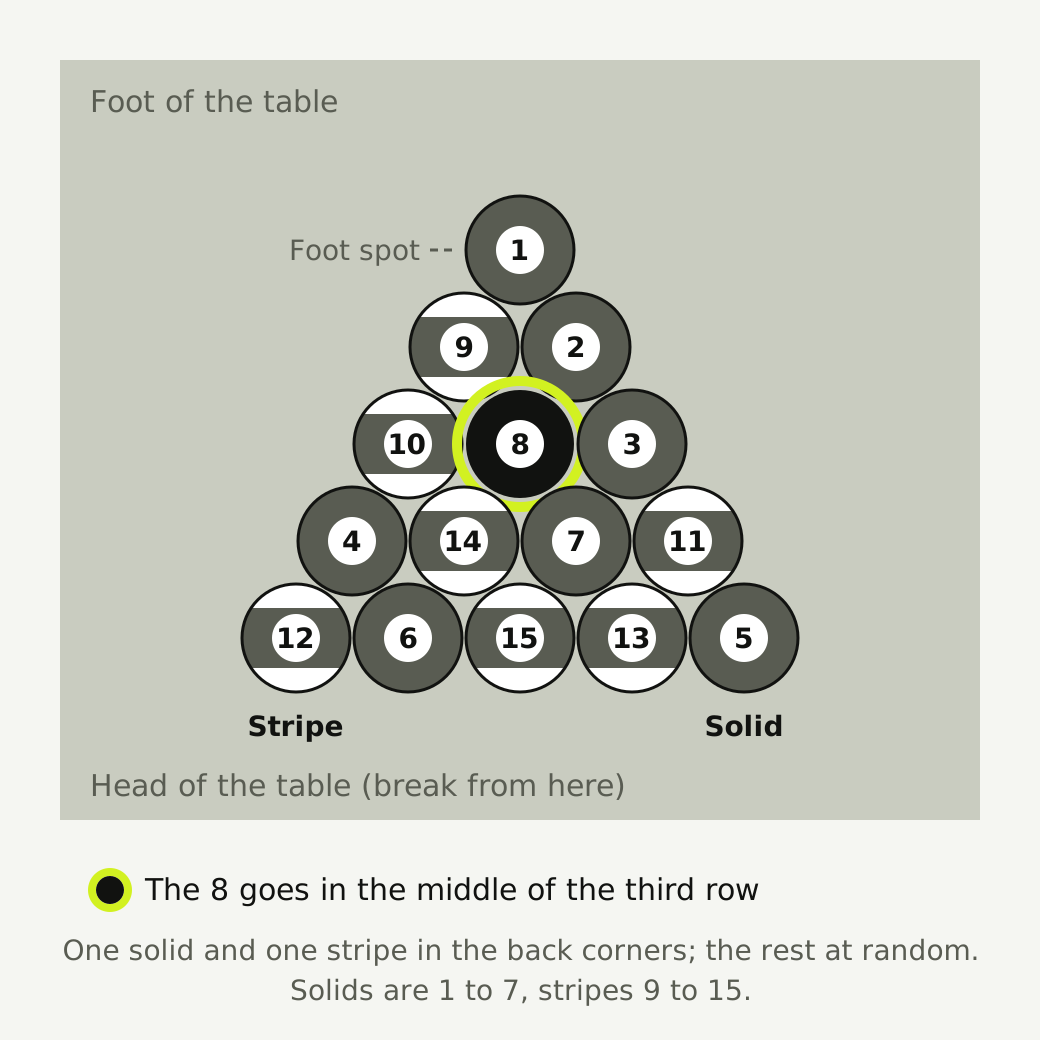
- Place the triangle with its point toward the head of the table and the front ball (the apex) on the foot spot [1].
- Put the 8 in the middle of the third row, the first ball directly behind the apex [1].
- Put one solid in one back corner and one stripe in the other [1].
- Fill the rest at random. The WPA rules say no purposeful pattern [1]; you do not need to alternate colours.
- Press the balls together so every ball touches its neighbours, then lift the triangle off without disturbing them. A loose rack makes for a dead break.
The break
The breaker places the cue ball anywhere behind the head string (in the "kitchen") and hits the rack as hard as they can control. Nothing needs to be called and any ball may be hit first [1].
- A ball goes down and there is no foul: the breaker keeps shooting, and the table stays open [1].
- Nothing goes down: at least four object balls must reach a cushion. If not, it is an illegal break, and the other player chooses to play the table as it lies, re-rack and break themselves, or make the breaker break again [1].
- The 8 goes down on a legal break: this is not a loss. The breaker chooses to spot the 8 (put it back on the foot spot) and carry on, or break again [1].
- The 8 goes down and the breaker fouls, for example by scratching: the opponent chooses to spot the 8 and take the cue ball in hand behind the head string, or break again [1].
- The cue ball goes in on the break (a scratch on the break): it is a foul. The opponent can play the table as it lies or take the cue ball in hand behind the head string [1].
Open table and choosing groups
Straight after the break the table is "open": nobody owns a group yet. On an open table you may hit any solid or stripe first, but not the 8 [1]. Under WPA rules you call the ball you intend to pot. If you pot your called ball legally, that group is yours and your opponent takes the other. If you miss, the table stays open and the turn passes [1].
Balls potted on the break never decide the groups. Many casual players skip calling on an open table and give the group to whoever pots the first ball after the break, which is how most apps play it too.
Taking turns
You stay at the table as long as you legally pot a ball from your own group on each shot [1]. If you miss, or pot only your opponent's ball without a foul, your turn ends and your opponent plays the balls where they lie. Balls of your opponent's group that you pot on a legal shot stay down and count for them.
Under WPA rules every shot apart from the break is called: you name the ball and the pocket, though not the cushions or kisses on the way, and obvious shots need no call [3]. You may call "safety" instead, which hands the table over after the shot even if you pot a ball [1].
Fouls and ball in hand
A foul ends your turn, and your opponent gets the cue ball in hand: they can place it anywhere on the table for their next shot [1]. The fouls that come up in every game are [1] [3]:
- Scratch: the cue ball goes into a pocket or off the table.
- Wrong ball first: the first ball the cue ball hits is not from your group. On an open table any solid or stripe is fine, but the 8 is not. Once your group is cleared, the 8 is your only legal first ball.
- No contact: the cue ball misses everything.
- No cushion after contact: if nothing is potted, then after the cue ball hits a ball, some ball (the cue ball or any object ball) must reach a cushion.
- Ball off the table: an object ball jumps off the table. It stays out (knocking the 8 off the table after the break loses the game, see below) [1].
- Touching or double hitting: touching any ball with your hand, clothes or cue, or hitting the cue ball twice, or pushing it.
- No foot on the floor while you shoot.
The WPA's three-fouls-in-a-row penalty from other games does not apply in 8-ball [3].
Winning and losing
You win by legally potting the 8, in the called pocket, after all seven of your group are down [1]. You lose straight away if, on any shot apart from the break, you [1]:
- pot the 8 before your group is cleared, even by accident,
- pot the 8 and foul on the same shot, for example the 8 goes in and the cue ball follows it,
- pot the 8 in a pocket you did not call, or
- knock the 8 off the table.
Your opponent fouling does not make you win, so you still need to finish the job. If the game reaches a position where neither player can make progress, the rack is declared a stalemate and the original breaker breaks again [1].
UK pub pool: how blackball differs
Most British pubs play blackball, on a smaller table (6 or 7 feet, with tight, rounded pockets) using unnumbered red and yellow balls plus a black [2] [4]. The aim is the same: clear your colour, then pot the black. The main differences under the WPA blackball rules [3]:
- The rack: the black sits on the foot spot, in the middle of the third row as in 8-ball, with the colours in a set pattern.
- Shots are not called, including the black.
- Groups are decided by the first normal shot after the break that pots balls of only one colour.
- After a foul the incoming player gets one free shot, on which they may hit any ball first, playing the cue ball where it lies or taking it in hand in baulk (the area behind the baulk line at the head of the table). Older pub and league rules gave "two shots" (two visits) instead, and many pubs still play it that way [4], so agree before you start.
- Potting your opponent's ball without also potting one of yours is a foul.
- The black on the break means a re-rack, and the same player breaks again.
Since 2022 the international eight-ball federation's own rules have dropped the free shot in favour of ball in hand anywhere [4], so rules vary by league. In a pub, the house rules on the wall win.
Strategy
Break for control
A full-power break that sends the cue ball flying often scratches. A firm, square hit on the apex ball, with the cue ball stopping near the middle of the table, spreads the rack and keeps you at the table.
Choose the easier group
On an open table, look at both groups before you shoot. The group with fewer balls tied up in clusters, or touching cushions, is usually the better one to take, even if the other group has the easier first shot.
Plan three balls ahead
Good players do not just pot the next ball; they play the cue ball to a spot that gives an easy shot at the ball after. Pick the order early, and save a ball near a pocket next to the 8 as your last one, so you can get position on the black.
Break up clusters early
Balls of yours that are touching each other or the 8 can stop you finishing. Use an easy pot to nudge into a cluster while you still have other balls to play.
Play safe when you have no shot
If there is nothing good to pot, leave the cue ball where your opponent cannot see their balls, or tucked against a cushion. A good safety often wins more games than a risky pot.
Mind the 8
Know where the 8 is on every shot. Hard shots near it can knock it into a pocket, which loses the game if your group is not cleared.
Common questions
- What happens if you pot the 8 on the break?
- Under WPA rules it is not a loss. On a legal break the breaker chooses to spot the 8 and carry on or break again; if the breaker also fouled, the opponent makes that choice [1]. Some pubs play it as an instant win, so check the house rules.
- Do you have to call the 8 ball?
- Yes, under WPA rules every shot except the break is called, and potting the 8 in a pocket you did not call loses the game [1]. In casual play people often only call the 8. UK blackball rules call nothing, not even the black [3].
- What happens if you scratch on the 8?
- If the 8 goes in and the cue ball also drops (or you foul in any other way on the same shot), you lose the game [1]. If you scratch while shooting at the 8 but the 8 stays up, it is an ordinary foul and your opponent gets ball in hand.
- Who gets solids and who gets stripes?
- Nobody owns a group after the break. Under WPA rules the first player to legally pot a ball they called takes that group [1]. Balls potted on the break do not decide it.
- Can you hit your opponent's ball first?
- Not once groups are set. The first ball the cue ball hits must be from your group, or the 8 once your group is cleared; otherwise it is a foul and your opponent gets ball in hand [1].
- Where can you put the cue ball after a foul?
- In 8-ball, anywhere on the table [1]. After a scratch on the break it goes behind the head string instead [1]. In UK blackball under WPA rules it goes in baulk, or you can play it where it lies [3].
- Is it two shots after a foul in pub pool?
- Traditionally, yes: older UK rules gave the incoming player two visits [4], and many pubs still play it. The WPA blackball rules give one free shot instead [3], and the current international rules give ball in hand with no free shot [4].
Sources
Checked on 8 November 2026.
- 1.World Pool-Billiard Association, Rules of Play, chapter 4: 8-Ball (effective 21 October 2026): https://wpapool.com/rules-of-play/
- 2.Wikipedia, "Eight-ball" (equipment, table and history): https://en.wikipedia.org/wiki/Eight-ball
- 3.World Pool-Billiard Association, Rules of Play, chapter 1 general rules, chapter 3 fouls and chapter 8: Blackball (PDF, effective 21 October 2026): https://wpapool.com/wp-content/uploads/2026/10/WPA-Rules-2026-10-21-211.pdf
- 4.Wikipedia, "Blackball (pool)" (UK tables, foul penalties under each rule set): https://en.wikipedia.org/wiki/Blackball_(pool)